Wooooooooooooooooooooooooooooooooooooot! I made it to day 100. I cannot believe that I have come to this day. This journey I embarked on is a nine month journey. Using a 30-day month as a template, that is about 270 days total Bible reading time. So, I'm 100/270 in, which is 37.037037...% Over a third done! It's still daunting having just under two-thirds of Scripture to read through, but if God has carried me this far, there is no reason to doubt Him now.
It has been an interesting couple of days. I feel like I have done nothing. I have spent the time job hunting, trying to see what I can do with my education, training, and experience. For two days, I came up empty handing sending my resumes and cover letters to all sorts of random places. I felt like I had no focus. Also, I felt like God and I were not doing well. I think the worry was clouding God from me. It is hard to describe, but in the same way that Asa from today's reading chose to not seek out the counsel of God and failed, I felt very much like I was failing. God was not with me. More precisely, I was not with God. I was separated from Him.
So, last night, I decided that I would spend today trying to regain that connection with my Lord. Now, I can truly say that I feel like He sees me again. That cloud has been rolled back. Thank you, Lord!
1309 pages to go!
Wednesday, December 29, 2010

Thursday, December 23, 2010
Day 95: 1 Chronicles 18:1-24:31
Today was all about preparation. This section of Scripture was all about how David prepared the Israelites to build the temple of the LORD. More specifically, he prepared things for Solomon his son, to take over when Solomon assumed kingship. Solomon was to build the temple because David had too much blood on his hands, the LORD said. The LORD was going to bless Solomon's reign with peace.
So, David brought in about 3450 metric tons of gold, 34500 metric tons of silver, and too much bronze to weigh, as well as prized Lebanese cedar to build the temple. He also took a census of the people so that he could designate priestly duties to the men of Levi, and set up officials to help Solomon in the administration of the worship of the LORD.
That got me thinking. What sort of legacy am I going to leave my children and their families? David did just about everything he could. First, he walked with God, prayed to God, sought the counsel of God, talked to God, got angry with God, and had a relationship with God. Secondly, he came to God and begged forgiveness when he knew he was in the wrong with the LORD. He made sure that he and his house was always in right standing with the LORD. Thirdly, he passed this on to his children, and they were blessed. He never ceased chasing God, and God loved him for it.
I hope and pray that I will be that kind of man, that kind of follower, that kind of husband, that kind of father. One who never grows faint of seeking and immersing myself in the immanent presence of God. Thank the LORD that Christ came, died in my place, rose again and offers me complete access to God through the grace of Christ.
Thank you, Lord.
Only 1333 pages to go!
So, David brought in about 3450 metric tons of gold, 34500 metric tons of silver, and too much bronze to weigh, as well as prized Lebanese cedar to build the temple. He also took a census of the people so that he could designate priestly duties to the men of Levi, and set up officials to help Solomon in the administration of the worship of the LORD.
That got me thinking. What sort of legacy am I going to leave my children and their families? David did just about everything he could. First, he walked with God, prayed to God, sought the counsel of God, talked to God, got angry with God, and had a relationship with God. Secondly, he came to God and begged forgiveness when he knew he was in the wrong with the LORD. He made sure that he and his house was always in right standing with the LORD. Thirdly, he passed this on to his children, and they were blessed. He never ceased chasing God, and God loved him for it.
I hope and pray that I will be that kind of man, that kind of follower, that kind of husband, that kind of father. One who never grows faint of seeking and immersing myself in the immanent presence of God. Thank the LORD that Christ came, died in my place, rose again and offers me complete access to God through the grace of Christ.
Thank you, Lord.
Only 1333 pages to go!
Wednesday, December 22, 2010
Day 94: 1 Chronicles 12:1-17:27
Today was the story of how Israel got back on track. It starts off with them not following God and ends with a huge celebration and the bringing home of the Ark of the Covenant. It is the literal and symbolic transfer of the presence of God back into the heart of Israel. it says that God was enthroned between the cherubim on the ark (1 Chr. 13:7).
At first they try to bring the ark back by waging war against Kiriath Jearim. Then they put it on an ox cart and haul it toward the city. Well, at one point that ox cart tipped or something, and the ark started to tip maybe to the point of falling over. A man named Uzzah reached out to grab it before it fell. It says that the LORD's anger burned against Uzzah, and the LORD struck Uzzah dead. At first this seemed really drastic and unnecessary. I have not decided if I still think it was. But I think the LORD was making a point very clear. He is holy. Holiness cannot stand impurity. I mean, this is the presence of the LORD we are talking about. This is not a small deal. This was God's manifest immanence among the people. Also, note that they were not carrying the ark, the glory of the LORD, properly. Recall that the Ark was to be carried on poles of acaciah wood by the priests. Here, they loaded the Ark on an ox cart. Like Brian Hardin from the Daily Audio Bible said in his commentary on this passage: we as Christians carry the glory of the LORD with us everyday thanks to the grace of God through the love of Christ. How are we carrying that glory? On an ox cart of our own ways? Or according to the ways that God wants us to, that honour him and develop our character like the acacia poles? The ox cart or poles? How will I carry God's glory?
Finally, later in the reading, they bring back the ark on the poles like they were supposed to, and God makes a covenant with David of prosperity and blessing of his descendants because David turned to the LORD. David sings a song recorded in the psalm in the passage. I love these lines, "Look to the LORD and his strength; seek his face always." (1 Chr. 16:11) "Do not touch my anointed ones; do my prophets no harm." (1 Chr. 16:22) "Tremble before him, all the earth!" (1 Chr. 16:30).
In chapter 17, there is a really cool line in David's prayer after God blessed him. He says, "Who am I, O LORD God, and what is my family, that you have brought me this far?" (1 Chr. 17:16) It reminds me of one of my favourite worship songs, where the chorus goes, "Because I'll never hold a picture of the whole horizon in my view, because I'll never rip the night in two, it makes me wonder, 'Who am I? Who am I? Who am I? And great are You!'"
1341 pages to go!
At first they try to bring the ark back by waging war against Kiriath Jearim. Then they put it on an ox cart and haul it toward the city. Well, at one point that ox cart tipped or something, and the ark started to tip maybe to the point of falling over. A man named Uzzah reached out to grab it before it fell. It says that the LORD's anger burned against Uzzah, and the LORD struck Uzzah dead. At first this seemed really drastic and unnecessary. I have not decided if I still think it was. But I think the LORD was making a point very clear. He is holy. Holiness cannot stand impurity. I mean, this is the presence of the LORD we are talking about. This is not a small deal. This was God's manifest immanence among the people. Also, note that they were not carrying the ark, the glory of the LORD, properly. Recall that the Ark was to be carried on poles of acaciah wood by the priests. Here, they loaded the Ark on an ox cart. Like Brian Hardin from the Daily Audio Bible said in his commentary on this passage: we as Christians carry the glory of the LORD with us everyday thanks to the grace of God through the love of Christ. How are we carrying that glory? On an ox cart of our own ways? Or according to the ways that God wants us to, that honour him and develop our character like the acacia poles? The ox cart or poles? How will I carry God's glory?
Finally, later in the reading, they bring back the ark on the poles like they were supposed to, and God makes a covenant with David of prosperity and blessing of his descendants because David turned to the LORD. David sings a song recorded in the psalm in the passage. I love these lines, "Look to the LORD and his strength; seek his face always." (1 Chr. 16:11) "Do not touch my anointed ones; do my prophets no harm." (1 Chr. 16:22) "Tremble before him, all the earth!" (1 Chr. 16:30).
In chapter 17, there is a really cool line in David's prayer after God blessed him. He says, "Who am I, O LORD God, and what is my family, that you have brought me this far?" (1 Chr. 17:16) It reminds me of one of my favourite worship songs, where the chorus goes, "Because I'll never hold a picture of the whole horizon in my view, because I'll never rip the night in two, it makes me wonder, 'Who am I? Who am I? Who am I? And great are You!'"
1341 pages to go!
Tuesday, December 21, 2010
Day 93: 1 Chronicles 8:1-11:47
This will be another very short post, as I am tired and need sleep.
Got the reading for today done. Again it was mostly lists of lineages of hard-to-pronounce names. Not all that exciting for a person who has a hard time keeping track of simple things like grocery lists.
1348 pages to go!
Got the reading for today done. Again it was mostly lists of lineages of hard-to-pronounce names. Not all that exciting for a person who has a hard time keeping track of simple things like grocery lists.
1348 pages to go!
Monday, December 20, 2010
Day 92: 1 Chronicles 5:1-7:40
At first, I thought to myself, "Awesome! Only three chapters." Then I started reading. Today was a large list of many hard to pronounce names. I understand that such genealogies serve their purpose, but it is not exactly light reading.
I'm hoping that readings like this will be one of those "boy, I'm glad I read that earlier" type readings, because I really got nothing of substance. Maybe later, when I'm reading a passage about a particular time in the Israelites' history, I'll be able to think about how it fits into the context of their genealogy.
It feels good to be back on track with readings. I missed it. I know that they are a lot of work, and that I have to make sure to take time out of my day to do them, but I always feel like God and I have reconnected after. I feel like I was able to stop, take time to reflect on him, and pray. It has done wonders in my spiritual and personal life.
Adam Smith talked about the invisible hand that moves and drives the "modern" capitalist economy. Well, in these readings, I can see the invivsible hand of God moving and driving through the history of Israel, bringing about the events and people that paved the way to Christ. I can also reflect and see the way He has moved in my life and brought to the place I am today: a strong, godly, gorgeous fiance, a woman of noble character; a strong family filled with the word and love of God; good godly friends; and my own personal relationship with Christ. For all of these things, I am humbled and give thanks.
1354 pages to go!
I'm hoping that readings like this will be one of those "boy, I'm glad I read that earlier" type readings, because I really got nothing of substance. Maybe later, when I'm reading a passage about a particular time in the Israelites' history, I'll be able to think about how it fits into the context of their genealogy.
It feels good to be back on track with readings. I missed it. I know that they are a lot of work, and that I have to make sure to take time out of my day to do them, but I always feel like God and I have reconnected after. I feel like I was able to stop, take time to reflect on him, and pray. It has done wonders in my spiritual and personal life.
Adam Smith talked about the invisible hand that moves and drives the "modern" capitalist economy. Well, in these readings, I can see the invivsible hand of God moving and driving through the history of Israel, bringing about the events and people that paved the way to Christ. I can also reflect and see the way He has moved in my life and brought to the place I am today: a strong, godly, gorgeous fiance, a woman of noble character; a strong family filled with the word and love of God; good godly friends; and my own personal relationship with Christ. For all of these things, I am humbled and give thanks.
1354 pages to go!
Friday, December 17, 2010
Days 88-89: 2 Kings 21:1-1 Chronicles 4:43
O.K. I will admit it. I am having a hard time keeping up with my Bible readings as of late. It does not help that these readings are very stale. Essentially I have been reading lists of ancient Near East names that are hard to pronounce. Just saying the names is distracting. By the end of a family genealogy, I have to stop, go back and figure out what the point of the list was.
I did come across the prayer of Jabez today. It has great significance for me. In around grade 11, a teacher of mine told us about the prayer and started reading a book about it in class. I thought that I had nothing to lose and I could see what it did in my life. I prayed the prayer everyday and I found myself noticing blessings coming into my life. It may be that I expected blessings and therefore noticed them when they came even when small. It was a daily reminder, a windlass that fixed my course on gratitude not complacency. It is not a vending machine prayer, or at least not ought to be one that fosters a consumerist attitude towards God. Rather it is a prayer that fosters daily turning to God, recognizing that everything I have and am comes from Him
Well, here is the Prayer of Jabez:
Well, I'm tired, and I think I will be heading to get some sleep soon.
1359 pages to go!
I did come across the prayer of Jabez today. It has great significance for me. In around grade 11, a teacher of mine told us about the prayer and started reading a book about it in class. I thought that I had nothing to lose and I could see what it did in my life. I prayed the prayer everyday and I found myself noticing blessings coming into my life. It may be that I expected blessings and therefore noticed them when they came even when small. It was a daily reminder, a windlass that fixed my course on gratitude not complacency. It is not a vending machine prayer, or at least not ought to be one that fosters a consumerist attitude towards God. Rather it is a prayer that fosters daily turning to God, recognizing that everything I have and am comes from Him
Well, here is the Prayer of Jabez:
Interesting anecdote: it was after praying this prayer for about a month or two, I started going out with the girl who would eventually become my fiance now. I thank the Lord everyday for her.
Jabez called on the God of Israel, "Oh, that you would bless me and enlarge my territory! Let your hand be with me, and keep me from harm so that I will be free from pain." And God granted his request. (1 Chr. 4:9-10)
Well, I'm tired, and I think I will be heading to get some sleep soon.
1359 pages to go!
Wednesday, December 15, 2010
Days 73-87: 2 Samuel 13:1-2 Kings 20:21
Wow...
I was so far behind. I finally caught up today.
There has been a very significant event in my life and the life of some very dear friends of mine. I don't know how many people actually read this blog, but even if one of you do, please pray for my friend. He has become very sick. I read today how God prolonged Hezekiah's life after he fell ill. He prayed, "'Remember, O LORD, how I have walked before you faithfully and with wholehearted devtion and have done what is good in your eyes.' And Hezekiah wept bitterly." (2 Kings 20:3). I feel like we have lived through the "wept bitterly" part, and now are just relying on God to do as He sees fit. But I still lift my friend up, asking God to move in him, to bestow a miracle.
Lord, I believe. Help me in my unbelief.
1385 pages to go.
I was so far behind. I finally caught up today.
There has been a very significant event in my life and the life of some very dear friends of mine. I don't know how many people actually read this blog, but even if one of you do, please pray for my friend. He has become very sick. I read today how God prolonged Hezekiah's life after he fell ill. He prayed, "'Remember, O LORD, how I have walked before you faithfully and with wholehearted devtion and have done what is good in your eyes.' And Hezekiah wept bitterly." (2 Kings 20:3). I feel like we have lived through the "wept bitterly" part, and now are just relying on God to do as He sees fit. But I still lift my friend up, asking God to move in him, to bestow a miracle.
Lord, I believe. Help me in my unbelief.
1385 pages to go.
Tuesday, November 30, 2010
Day 72: 2 Samuel 6:1-12:31
Today I read the story of how God struck down Uzzah when he touched the ark of the covenant after the Israelites put the ark on an ox cart rather than carrying it on poles. I remember listening to a Daily Audio Bible podcast where the host, Brian, explained a little of what seemed like such a harsh punishment. The ark was supposed to be carried by the Levites on poles. The ark was moved around on an ox cart, like the Philistines had done. It seems that God was trying to make a point. The ark was the glory of God on earth. So, how are we carrying that glory? Are we throwing it onto an ox cart and shuffling it around? Or are we carrying God's glory like he intended us to carry it? I love the way Brian explained it.
This reading also contained the famous story of David and Bathsheba, the wife of Uriah. Despite David's adulterous and murderous behaviour, God uses the situation to carry on the lineage of a blessed people tracing all the way back to Noah and Abraham. Eventually, it will lead to Jesus Christ. I love how Christ's ancestry includes prostitutes, extramarital partners, theives, etc. God was able to work through the lives of sinners who turned to God and eventually put their faith in Him. Cool beans. For example, Bathsheba became pregnant after David slept with her. Bathsheba gave birth to the famous Solomon. Solomon would become the richest, most powerful, and wisest man who ever lived.
David's deed does not go unpunished. Nathan, a prophet, speaks to David on behalf of God, rebuking David for his sin, saying, "I am going to bring calamity upon you. Before your very eyes I will take your wives and give them to one who is close to you, and he will lie with your wives in broad daylight. You did it in secret, but I will do this thing in broad daylight before all Israel... The LORD has taken away your sin. You are not going to die. But because by doing this you have made the enemies of the LORD show utter contempt, the son born to you will die" (2 Sam. 12:11-13). The LORD killed David's first child with Bathsheba, but eventually, they gave birth to Solomon. The Lord moves in situations and can use even those of us who have messed up to bring divinity, love, and justice into the world. Thank you, Lord!
1510 pages to go!
This reading also contained the famous story of David and Bathsheba, the wife of Uriah. Despite David's adulterous and murderous behaviour, God uses the situation to carry on the lineage of a blessed people tracing all the way back to Noah and Abraham. Eventually, it will lead to Jesus Christ. I love how Christ's ancestry includes prostitutes, extramarital partners, theives, etc. God was able to work through the lives of sinners who turned to God and eventually put their faith in Him. Cool beans. For example, Bathsheba became pregnant after David slept with her. Bathsheba gave birth to the famous Solomon. Solomon would become the richest, most powerful, and wisest man who ever lived.
David's deed does not go unpunished. Nathan, a prophet, speaks to David on behalf of God, rebuking David for his sin, saying, "I am going to bring calamity upon you. Before your very eyes I will take your wives and give them to one who is close to you, and he will lie with your wives in broad daylight. You did it in secret, but I will do this thing in broad daylight before all Israel... The LORD has taken away your sin. You are not going to die. But because by doing this you have made the enemies of the LORD show utter contempt, the son born to you will die" (2 Sam. 12:11-13). The LORD killed David's first child with Bathsheba, but eventually, they gave birth to Solomon. The Lord moves in situations and can use even those of us who have messed up to bring divinity, love, and justice into the world. Thank you, Lord!
1510 pages to go!
Monday, November 29, 2010
Days 67-71: 1 Samuel 18:1-2 Samuel 5:25
Got the reading done today! Despite the chaos in my life right now, it is nice to come back to the Word as a foundation for my day.
1519 pages to go!
1519 pages to go!
Wednesday, November 24, 2010
Day 66: 1 Samuel 14:1-17:58
This will be a short post today, but it was certainly not a dry read today. Today was the rise of David. More correctly, this was the story of how David sought God's will for the people of Israel and how God used him for His glory.
It is also the story of the decline of Saul, a leader chosen by God, but who steadily forgot God or relied on his own strength instead of completely trusting God.
My favourite passages from the reading are in chapter 16. Saul and Samuel were looking for someone to succeed Saul's throne. Saul was looking for a strong, brave, courageous man. Saul was looking for tangibles. The LORD rebukes him when he says, "The LORD does not look at the things man looks at. Man looks at the outward appearance, but the LORD looks at the heart" (1 Sam. 16:7). The LORD craves righteousness, a clean heart, a passionate God-seeking, righteousness-seeking, justice-seeking, and love-filled heart.
Today was the story of David and Goliath. But it was not a story of big guy versus little guy or brawn versus brain. It has everything to do with righteousness versus wickedness. It seems to me to be a story of celebrating not the physical attributes of people, but their faith, love of God, and character. Without God, the fight would have been no match, and David would have been just another tally mark in a long list of dead Israelites by Goliath. It seems to me that the difference highlighted by the Scripture is David's complete faith in God, his righteousness for standing up for what was right. This is juxtaposed against two different people: Saul and Goliath. Saul seems to represent the those of hollow faith. Goliath represented wickedness. God gave David victory, again highlighting that He works through the "least of these", those of character and faith, love and justice, not of arrogance and self-reliance.
I am generally an anxious person. I will admit it. I think that is why 1 Sam. 17:47 spoke to me so vividly. "All those gather here will know that it is not by sword or spear that the LORD saves; for the battle is the LORD's..." Why should I worry about the outcome of the turmoil in my life? The whole thing, both sides, are His. Either outcome will be OK, because He loves me and He sees me (Gen. 16:13). I will never walk alone. Like David, I need to walk in faith. Though what I have in strength and knowledge is a sling and stones against the scaled armor and bronze spears of the trials I will face in my life, the LORD sees me. He knows me, and there is peace when He is near me.
It is also the story of the decline of Saul, a leader chosen by God, but who steadily forgot God or relied on his own strength instead of completely trusting God.
My favourite passages from the reading are in chapter 16. Saul and Samuel were looking for someone to succeed Saul's throne. Saul was looking for a strong, brave, courageous man. Saul was looking for tangibles. The LORD rebukes him when he says, "The LORD does not look at the things man looks at. Man looks at the outward appearance, but the LORD looks at the heart" (1 Sam. 16:7). The LORD craves righteousness, a clean heart, a passionate God-seeking, righteousness-seeking, justice-seeking, and love-filled heart.
Today was the story of David and Goliath. But it was not a story of big guy versus little guy or brawn versus brain. It has everything to do with righteousness versus wickedness. It seems to me to be a story of celebrating not the physical attributes of people, but their faith, love of God, and character. Without God, the fight would have been no match, and David would have been just another tally mark in a long list of dead Israelites by Goliath. It seems to me that the difference highlighted by the Scripture is David's complete faith in God, his righteousness for standing up for what was right. This is juxtaposed against two different people: Saul and Goliath. Saul seems to represent the those of hollow faith. Goliath represented wickedness. God gave David victory, again highlighting that He works through the "least of these", those of character and faith, love and justice, not of arrogance and self-reliance.
I am generally an anxious person. I will admit it. I think that is why 1 Sam. 17:47 spoke to me so vividly. "All those gather here will know that it is not by sword or spear that the LORD saves; for the battle is the LORD's..." Why should I worry about the outcome of the turmoil in my life? The whole thing, both sides, are His. Either outcome will be OK, because He loves me and He sees me (Gen. 16:13). I will never walk alone. Like David, I need to walk in faith. Though what I have in strength and knowledge is a sling and stones against the scaled armor and bronze spears of the trials I will face in my life, the LORD sees me. He knows me, and there is peace when He is near me.
Tuesday, November 23, 2010
Day 65- 1 Samuel 7:1-13:23
In today's reading: Israel asks for a king, one of the least of the least clans in the least tribe of Israel gets anointed as king, and God's forgiveness saves the day (and boy, did I need to hear that tonight).
I read the story of Saul tonight. He was the least in his family (though he was head and shoulders taller than anyone else). His family was the least in his tribe of Benjamin. Benjamin was the last (and therefore least) tribe of Israel. He was the lowest of the low citizen of Israel.
The people of Israel had been wanting a king instead of having God as the head of state and a priesthood to serve God. I do not know exactly why. It would make explaining their political structure easier to surrounding nations and would make things a little easier to understand for some. I think they were fed up with not being able to see God. They wanted something tangible, albeit far less wonderful and perfect as God.
God seemed displeased with this turn of events, but at the same time, seemed to want to respect their free will as a nation. So, he set into motion events that would lead to the appointing of Saul. Saul's family lost some goats. He and a couple other people go looking for them. They get hungry and go to find the man of God in the nearest town. People point out the way. Meanwhile Samuel was going to the highest place, a makeshift temple to God, to prepare an offering to God on the people's behalf. As God planned, their paths crossed, and God told Samuel that Saul was to be Israel's king. So, he invited him for a meal and anointed him.
I love the idea of an anointing. They poured olive oil over Saul to signify God's blessing on him. I remember when I was young and very sick; my church pastor prayed over me and anointed my forehead with oil. It was a such a beautiful symbol of God's presence around me.
God makes Saul the King. I love the next passage:
"As Saul turned to leave Samuel, God changed Saul's heart, and all these signs were fulfilled that day" (1 Sam. 10:9). I so desperately want to say that of my heart. I want God to change my heart. It was then that God really started moving through Saul, and I crave that for my own life too.
Soon after, Samuel prepares himself to die, as he is old. His last speech to Israel recounts the ways in which God had delivered Israel time and time again despite Israel's lack of faith, sort of how God has forgiven me again and again despite my constant shortcomings. The point of his speech, to me it seems, is to highlight how the LORD has been in complete control of Israel, protecting her despite her unfaithfulness. He points to God's incredible power and providence. Samuel wants to make a point to Israel to show them just how powerful God is. So, he calls on God to send thunder and rain, even though it was the beginning of a dry spell when dry desert wind comes over Canaan (I checked here). God sends thunder and rain. The people stood in awe (1 Sam. 12:18). The people were afraid of God, fearing that they would be wiped out because of their sin.
The next verse brought me so much comfort. "Do not be afraid," Samuel replied, "You have done all this evil; yet do not turn away from the LORD, but serve the LORD with all your heart... For the sake of his great name the LORD will not reject his people, because the LORD was pleased to make you his own" (1 Sam. 12:20, 22). Thank God for his forgiveness, without which there would be no hope, no redemption.
Well, that was all that spoke to me tonight.
1557 pages to go!
I read the story of Saul tonight. He was the least in his family (though he was head and shoulders taller than anyone else). His family was the least in his tribe of Benjamin. Benjamin was the last (and therefore least) tribe of Israel. He was the lowest of the low citizen of Israel.
The people of Israel had been wanting a king instead of having God as the head of state and a priesthood to serve God. I do not know exactly why. It would make explaining their political structure easier to surrounding nations and would make things a little easier to understand for some. I think they were fed up with not being able to see God. They wanted something tangible, albeit far less wonderful and perfect as God.
God seemed displeased with this turn of events, but at the same time, seemed to want to respect their free will as a nation. So, he set into motion events that would lead to the appointing of Saul. Saul's family lost some goats. He and a couple other people go looking for them. They get hungry and go to find the man of God in the nearest town. People point out the way. Meanwhile Samuel was going to the highest place, a makeshift temple to God, to prepare an offering to God on the people's behalf. As God planned, their paths crossed, and God told Samuel that Saul was to be Israel's king. So, he invited him for a meal and anointed him.
I love the idea of an anointing. They poured olive oil over Saul to signify God's blessing on him. I remember when I was young and very sick; my church pastor prayed over me and anointed my forehead with oil. It was a such a beautiful symbol of God's presence around me.
God makes Saul the King. I love the next passage:
"As Saul turned to leave Samuel, God changed Saul's heart, and all these signs were fulfilled that day" (1 Sam. 10:9). I so desperately want to say that of my heart. I want God to change my heart. It was then that God really started moving through Saul, and I crave that for my own life too.
Soon after, Samuel prepares himself to die, as he is old. His last speech to Israel recounts the ways in which God had delivered Israel time and time again despite Israel's lack of faith, sort of how God has forgiven me again and again despite my constant shortcomings. The point of his speech, to me it seems, is to highlight how the LORD has been in complete control of Israel, protecting her despite her unfaithfulness. He points to God's incredible power and providence. Samuel wants to make a point to Israel to show them just how powerful God is. So, he calls on God to send thunder and rain, even though it was the beginning of a dry spell when dry desert wind comes over Canaan (I checked here). God sends thunder and rain. The people stood in awe (1 Sam. 12:18). The people were afraid of God, fearing that they would be wiped out because of their sin.
The next verse brought me so much comfort. "Do not be afraid," Samuel replied, "You have done all this evil; yet do not turn away from the LORD, but serve the LORD with all your heart... For the sake of his great name the LORD will not reject his people, because the LORD was pleased to make you his own" (1 Sam. 12:20, 22). Thank God for his forgiveness, without which there would be no hope, no redemption.
Well, that was all that spoke to me tonight.
1557 pages to go!
Monday, November 22, 2010
Day 64- Ruth 4:1-1 Samuel 6:21
Longer read today. Later night. Shorter fuse. Sleepier mind.
I finished Ruth today. Beautiful ending. It was cool to see how God moved in her life. Here was a Moabite woman- not a Jew- who met a kind and loving man, Boaz. Boaz married her and they gave birth to an ancestor of David, the ancestor of Christ. Very cool.
I started Samuel today. I look forward to the rest of it.
Short post. Tired brain. My apologies.
1566 pages to go!
I finished Ruth today. Beautiful ending. It was cool to see how God moved in her life. Here was a Moabite woman- not a Jew- who met a kind and loving man, Boaz. Boaz married her and they gave birth to an ancestor of David, the ancestor of Christ. Very cool.
I started Samuel today. I look forward to the rest of it.
Short post. Tired brain. My apologies.
1566 pages to go!
Friday, November 19, 2010
Days 60-61: Judges 12:1-Ruth 3:18
Finished Judges today. It ended so sadly. First was the story of Samson, a Nazarite. As far as I can tell, that essentially means one who is set apart for God by oath for life punishable by death. God rose up Samson in a time of turmoil for Israel. He was to lead the people, and he had superhuman strength. He ripped a lion in two, for goodness sake! To make his oath visible, God told him never to cut his hair or shave his beard. So, by the time we meet Samson, he has long dread locks and a huge manly beard to rival Grizzly Adams, ZZ Top, and the dreadlocks of Bob Marley.
But as with all the later judges of Israel, Samson soon fell into temptation of the immediacy of the idols of the nations around him. God in the Old Testament was so nebulous. He was terrifying and powerful when He chose to reveal Himself in true form, but for the most part, He speaks through people and interpretation. So, I can see why the Israelites would be attracted to having something they could grasp, see, set limits to, etc. An idol had form and shape and definition. God was/is not that. He fell in love with Delilah, who was asked by "the Rulers of the Philistines" (who were Israel's long standing enemy) to figure out the secret to his strength. She would tie his wrists and three times he lied to her about what would make him lose his strength; each time he would escape the binds. So, he fell into temptation by revealing the secret to his strength, that he was to not cut his hair or shave his beard, after she continued asking him questions. She cut some dreadlocks off his head and he lost all strength. He was taken to a stadium where he was to "entertain" the Philistines. What that meant, I can only imagine. It probably involved ridicule, torture, and humiliation.
Finally Samson asked God to grant him strength one last time so he could kill the Philistines mocking him and God. So, God gave him his strength back. Samson pushed against the pillars of the stadium and everything came crashing down killing everyone, including Samson. It was his final mission. Tragic.
I started Ruth today, which is a breath of fresh air. Ruth is the story of a widow and her widow mother-in-law. Ruth was a Moabite (a pagan nation) scheduled to marry her husband, when he died. Her mother-in-law (Naomi) also lost her husband. Instead of going back home to find another husband, Ruth commits herself to staying by Naomi's side. It's a beautiful story of love, self-sacrifice, and commitment. Ruth ends up working as a farmhand for a man named Boaz. She is a pagan, and so is relegated to the task of gleaning from the field whatever she can to eat. Boaz shows her great grace, though. He tells his workers to skip certain sections of the barley field and to allow Ruth space so that she can have plenty to eat and be valued as a person. Naomi tells Ruth to meet Boaz on the threshing room floor. At one point, he was in the threshing room floor after work, sleeping. Ruth came in to lie at his feet. Boaz sees this as a beautiful gesture and blesses her with an ephah of barley (about 35 litres!). I can just tell that the structure of this book is building up romantic sparks and deep love between Ruth and Boaz. I cannot wait to read the rest! God is so good.
The Lord provides. Jehovah Jireh (as the Jewish would say).


But as with all the later judges of Israel, Samson soon fell into temptation of the immediacy of the idols of the nations around him. God in the Old Testament was so nebulous. He was terrifying and powerful when He chose to reveal Himself in true form, but for the most part, He speaks through people and interpretation. So, I can see why the Israelites would be attracted to having something they could grasp, see, set limits to, etc. An idol had form and shape and definition. God was/is not that. He fell in love with Delilah, who was asked by "the Rulers of the Philistines" (who were Israel's long standing enemy) to figure out the secret to his strength. She would tie his wrists and three times he lied to her about what would make him lose his strength; each time he would escape the binds. So, he fell into temptation by revealing the secret to his strength, that he was to not cut his hair or shave his beard, after she continued asking him questions. She cut some dreadlocks off his head and he lost all strength. He was taken to a stadium where he was to "entertain" the Philistines. What that meant, I can only imagine. It probably involved ridicule, torture, and humiliation.
Finally Samson asked God to grant him strength one last time so he could kill the Philistines mocking him and God. So, God gave him his strength back. Samson pushed against the pillars of the stadium and everything came crashing down killing everyone, including Samson. It was his final mission. Tragic.
I started Ruth today, which is a breath of fresh air. Ruth is the story of a widow and her widow mother-in-law. Ruth was a Moabite (a pagan nation) scheduled to marry her husband, when he died. Her mother-in-law (Naomi) also lost her husband. Instead of going back home to find another husband, Ruth commits herself to staying by Naomi's side. It's a beautiful story of love, self-sacrifice, and commitment. Ruth ends up working as a farmhand for a man named Boaz. She is a pagan, and so is relegated to the task of gleaning from the field whatever she can to eat. Boaz shows her great grace, though. He tells his workers to skip certain sections of the barley field and to allow Ruth space so that she can have plenty to eat and be valued as a person. Naomi tells Ruth to meet Boaz on the threshing room floor. At one point, he was in the threshing room floor after work, sleeping. Ruth came in to lie at his feet. Boaz sees this as a beautiful gesture and blesses her with an ephah of barley (about 35 litres!). I can just tell that the structure of this book is building up romantic sparks and deep love between Ruth and Boaz. I cannot wait to read the rest! God is so good.
The Lord provides. Jehovah Jireh (as the Jewish would say).
Wednesday, November 17, 2010
Days 58-59: Judges 2:1-11:40
I cannot believe how fast I am going through this Bible. When I started this journey, I looked down at Genesis 1:1 with some dismay. "How am I ever going to get to Revelation 22:21?" I thought. I suppose by the grace of God and some sweet reading skills that I picked up in university, I have managed to get through the first 6.5 books of the Bible. Only 60.5 to go!
Today's reading was of the judges of Israel. I think what happened was, after Joshua died, that was the end of the generation that was in the desert. So, with him, all of the experience in the desert with the LORD was gone, and probably only kept through oral tradition. Without a proper leader in place, Israel turned to the religions of the gentile peoples. God was not happy, and sold them into slavery of these gentile people to sort of "discipline" them.
Eventually, God raises up the Judges, people to command Israel's armies and mediate Israel's civil disputes. First comes Othniel. Fun fact: I learned that the English "iel" is sort of an attempt to get at a Hebrew phrase that means "God", as in YHWH, the I Am/Will Be. Cool beans. Othniel was appointed by God to deliver Israel from the Mesopotamian king named Cushan-Rishathaim, who apparently reigned around 1200 BC. After that, they lived in peace and Othniel died.
Then they started sinning after Othniel's generation died off. So, God sent another kingdom to enslave Israel. They cried out to God, and He sent Ehud, a lefty to kill the king. So, normally a man wore a sword on his left thigh to be drawn with his right hand. In that culture, they would look only at the left thigh. Because of this, he was able to sneak his sword in and kill the fat king. Israel was free again.
Then there was Deborah. Hooray for strong, prominent women in the Bible! Deborah rose to become a judge after Israel, AGAIN, sinned against God. Long story short, she advises the military commander (Barak, but not Obama) how to defeat the other army, and says that the enemy named Sisera. She prophecies that Sisera will be killed by a woman. It turns out later in the story that Sisera comes to a poor woman's tent desperate for water. After he falls asleep, this woman, Jael, grabs a tent peg and a hammer, and drives the tent peg through his temple. I wonder what sort of witty one-liner Horatio would come up for that one.
Gideon is the next.
Then there is this weird prophecy. After Gideon's death, his son, Abimelech goes bad and kills his seventy brothers, all except one: Jotham. Jotham then prophecies.
"8 One day the trees went out to anoint a king for themselves. They said to the olive tree, ‘Be our king.’
9 “But the olive tree answered, ‘Should I give up my oil, by which both gods and humans are honored, to hold sway over the trees?’
10 “Next, the trees said to the fig tree, ‘Come and be our king.’
11 “But the fig tree replied, ‘Should I give up my fruit, so good and sweet, to hold sway over the trees?’
12 “Then the trees said to the vine, ‘Come and be our king.’
13 “But the vine answered, ‘Should I give up my wine, which cheers both gods and humans, to hold sway over the trees?’
14 “Finally all the trees said to the thornbush, ‘Come and be our king.’
15 “The thornbush said to the trees, ‘If you really want to anoint me king over you, come and take refuge in my shade; but if not, then let fire come out of the thornbush and consume the cedars of Lebanon!’"
I'm not sure what it means, but it was definitely interesting. It was almost as if it was prophecying that the good people in Israel would not give up their professions to lead Israel. Only the thornbushes would crave that power. I do not know for sure though. Here was a promising website that might explain it, though. It turns out the olive tree represents the Holy Spirit, the fig tree represents God the Father, the vine represents Christ, but in the end the people chose the thorns which represent the sinful world, and importantly not any of the Trinity.
Lest I turn my back on Him who loved me first. Time and time again, I see in Scripture that God in His infinite love and wisdom craves righteousness for me and my household. Like a good parent, He disciplines those He loves. I will be honest, there are days when He feels more like a story in an old book than a living God, moving maker of heaven and earth, immanent in my daily life. It is times like those, like tonight for example, when I quote the father of sick child in Christ's parable to myself. "Lord, I believe. Help me in my unbelief." (Mark 9:24).
1601 pages to go!
Today's reading was of the judges of Israel. I think what happened was, after Joshua died, that was the end of the generation that was in the desert. So, with him, all of the experience in the desert with the LORD was gone, and probably only kept through oral tradition. Without a proper leader in place, Israel turned to the religions of the gentile peoples. God was not happy, and sold them into slavery of these gentile people to sort of "discipline" them.
Eventually, God raises up the Judges, people to command Israel's armies and mediate Israel's civil disputes. First comes Othniel. Fun fact: I learned that the English "iel" is sort of an attempt to get at a Hebrew phrase that means "God", as in YHWH, the I Am/Will Be. Cool beans. Othniel was appointed by God to deliver Israel from the Mesopotamian king named Cushan-Rishathaim, who apparently reigned around 1200 BC. After that, they lived in peace and Othniel died.
Then they started sinning after Othniel's generation died off. So, God sent another kingdom to enslave Israel. They cried out to God, and He sent Ehud, a lefty to kill the king. So, normally a man wore a sword on his left thigh to be drawn with his right hand. In that culture, they would look only at the left thigh. Because of this, he was able to sneak his sword in and kill the fat king. Israel was free again.
Then there was Deborah. Hooray for strong, prominent women in the Bible! Deborah rose to become a judge after Israel, AGAIN, sinned against God. Long story short, she advises the military commander (Barak, but not Obama) how to defeat the other army, and says that the enemy named Sisera. She prophecies that Sisera will be killed by a woman. It turns out later in the story that Sisera comes to a poor woman's tent desperate for water. After he falls asleep, this woman, Jael, grabs a tent peg and a hammer, and drives the tent peg through his temple. I wonder what sort of witty one-liner Horatio would come up for that one.
Gideon is the next.
Then there is this weird prophecy. After Gideon's death, his son, Abimelech goes bad and kills his seventy brothers, all except one: Jotham. Jotham then prophecies.
"8 One day the trees went out to anoint a king for themselves. They said to the olive tree, ‘Be our king.’
9 “But the olive tree answered, ‘Should I give up my oil, by which both gods and humans are honored, to hold sway over the trees?’
10 “Next, the trees said to the fig tree, ‘Come and be our king.’
11 “But the fig tree replied, ‘Should I give up my fruit, so good and sweet, to hold sway over the trees?’
12 “Then the trees said to the vine, ‘Come and be our king.’
13 “But the vine answered, ‘Should I give up my wine, which cheers both gods and humans, to hold sway over the trees?’
14 “Finally all the trees said to the thornbush, ‘Come and be our king.’
15 “The thornbush said to the trees, ‘If you really want to anoint me king over you, come and take refuge in my shade; but if not, then let fire come out of the thornbush and consume the cedars of Lebanon!’"
I'm not sure what it means, but it was definitely interesting. It was almost as if it was prophecying that the good people in Israel would not give up their professions to lead Israel. Only the thornbushes would crave that power. I do not know for sure though. Here was a promising website that might explain it, though. It turns out the olive tree represents the Holy Spirit, the fig tree represents God the Father, the vine represents Christ, but in the end the people chose the thorns which represent the sinful world, and importantly not any of the Trinity.
Lest I turn my back on Him who loved me first. Time and time again, I see in Scripture that God in His infinite love and wisdom craves righteousness for me and my household. Like a good parent, He disciplines those He loves. I will be honest, there are days when He feels more like a story in an old book than a living God, moving maker of heaven and earth, immanent in my daily life. It is times like those, like tonight for example, when I quote the father of sick child in Christ's parable to myself. "Lord, I believe. Help me in my unbelief." (Mark 9:24).
1601 pages to go!
Monday, November 15, 2010
Day 57 : Joshua 21:1-Judges 1:36
I finished Joshua, and I have started Judges. Well, in Joshua, there was this beautiful passage that has sort of summed up some themes that I have been seeing in Scripture since the beginning- how we balance fearing the LORD and loving him.
Josh. 21: 5, "But be very careful to keep the commandment and the law that Moses the servant of the LORD gave you: To love the LORD your God, to walk in all his ways, to obey his commands, to hold fast to him and to serve him with all your heart and all your soul." That is the LOVE part.
Then there was the FEAR part. Josh.23:14-16, "...You know with all your heart and soul that not one of all the good promises the LORD your God have you has failed. Every promise has been fulfilled; not one has failed. But just as every good promise of the LORD your God has come true, so the LORD will brin on you all the evil he has threatened, until he has destroyed you from this good land he has given you. If you violate the covenant of the LORD you God, which he commanded you, and go and serve other gods and bow down to them, the LORD's anger will burn against you, and you will quickly persh from the good land he has given you. Josh. 24:14, "Now fear the LORD and serve him with all faithfulness."
Then the LOVE part. Josh. 24:15, "But as for me and my household, we will serve the LORD."
Joshua ends with the Israelites settling in their Promised Land. Awesome!
Judges has so far involved a little more conquest and cutting off of the conquered kings' toes and thumbs. A little barbaric, but it seems to be a symbolic act as well. By doing so, they render the kings useless. They can no longer run swiftly or wield arms against them. God's power to protect His children brings kings to their knees.
Cool stuff.
1619 pages to go!
Josh. 21: 5, "But be very careful to keep the commandment and the law that Moses the servant of the LORD gave you: To love the LORD your God, to walk in all his ways, to obey his commands, to hold fast to him and to serve him with all your heart and all your soul." That is the LOVE part.
Then there was the FEAR part. Josh.23:14-16, "...You know with all your heart and soul that not one of all the good promises the LORD your God have you has failed. Every promise has been fulfilled; not one has failed. But just as every good promise of the LORD your God has come true, so the LORD will brin on you all the evil he has threatened, until he has destroyed you from this good land he has given you. If you violate the covenant of the LORD you God, which he commanded you, and go and serve other gods and bow down to them, the LORD's anger will burn against you, and you will quickly persh from the good land he has given you. Josh. 24:14, "Now fear the LORD and serve him with all faithfulness."
Then the LOVE part. Josh. 24:15, "But as for me and my household, we will serve the LORD."
Joshua ends with the Israelites settling in their Promised Land. Awesome!
Judges has so far involved a little more conquest and cutting off of the conquered kings' toes and thumbs. A little barbaric, but it seems to be a symbolic act as well. By doing so, they render the kings useless. They can no longer run swiftly or wield arms against them. God's power to protect His children brings kings to their knees.
Cool stuff.
1619 pages to go!
Sunday, November 14, 2010
Day 51-54: Deuteronomy 32:1-Joshua 20:9
I finally caught up! My brain is too tired to write anything of significance. Like Pastor Tom said today in church, we need to tend to the stream and clear the pipe of debris to receive a constant flow of fresh, clean, and crisp water from the mountain river. Tonight, I feel like God helped me scrape some sludge and silt out the the way of receiving His divine, refreshing water.
Today, I read about Moses' death, the Israelites' crossing into the Promised Land, the allottment of land (wow, that was taxing!!!), and then the designation of the cities of refuge for the Israelites in Canaan.
Not much else tonight. I am way too tired.
1631 pages to go!
Today, I read about Moses' death, the Israelites' crossing into the Promised Land, the allottment of land (wow, that was taxing!!!), and then the designation of the cities of refuge for the Israelites in Canaan.
Not much else tonight. I am way too tired.
1631 pages to go!
Monday, November 8, 2010
Days 46-50: Deuteronomy 14:1-31:30
Well, a lot of Bible reading has happened between the last blog and today's post. More or less, the theme of the reading has been to obey the LORD, because then he will bless you and be with you and be for you. Disobedience leads to a curse.
Another big theme in these passages is to purge evil from their nation, at all costs (Duet. 13:5, 17:7, 19:19, 21:21, 22:22, 24:7). Israel had to kill those from among herself that turned from God. Often, this meant that the person who violated the covenant would be stoned so that they would be an example for the rest of Israel. It seems that most things up until now were forgivable with a sacrifice presented at the Tabernacle, but these offenses seem to be particularly wicked to God.
Those who worshiped idols or other gods were to be put to death (Deut. 16:21-17:7).
There is a passage about the kings in Israel. When they conquered a new land, they were to put a king to rule over that land on behalf of God. What I found interesting was that God commanded the king not to own an excessive amount of wealth (measured by horses, number of wives, and gold and silver). He was to have as little of these as possible (Deut. 17:16-17). He was to revere God, and consider himself an equal to his fellow Israelites when it came to the Law (Deut. 17:20). It reminded me of Plato's philosopher king. I think he said something like the best ruler was the one who wanted power the least because they would be least tempted to abuse that power.
I like God's social justice commands. In Deut. 15:10-11, there is a beautiful passage about lending to the poor in Israel. "Give generously to him and do so without a grudging heart; then because of this the LORD your God will bless you in all your work and in everything you put your hand to. There will always be poor people in the land. Therefore I command you to be openhanded toward your bothers and toward the poor and needy in your land." I am learning that God is multi-faceted. He can be terrifying and militant, and he can also be immanent, nurturing, and empathic.
In chapter 24, Moses outlines the law for newly weds. Men who are recently married were apparently exempt from military service. He is to love his wife and stay with her. I like this verse: "For one year he is to be free to stay at home and bring happiness to the wife he has married" (Deut. 24:5).
It was an interesting read, but I am finding that I am growing more and more impatient with these readings. To be honest, they seem awfully repetitive. I like reading them, but at times it feels like drudging through policy text. I am hoping that Joshua will be more exciting to read.
Well, that's all for today. 1667 pages to go!
Another big theme in these passages is to purge evil from their nation, at all costs (Duet. 13:5, 17:7, 19:19, 21:21, 22:22, 24:7). Israel had to kill those from among herself that turned from God. Often, this meant that the person who violated the covenant would be stoned so that they would be an example for the rest of Israel. It seems that most things up until now were forgivable with a sacrifice presented at the Tabernacle, but these offenses seem to be particularly wicked to God.
Those who worshiped idols or other gods were to be put to death (Deut. 16:21-17:7).
There is a passage about the kings in Israel. When they conquered a new land, they were to put a king to rule over that land on behalf of God. What I found interesting was that God commanded the king not to own an excessive amount of wealth (measured by horses, number of wives, and gold and silver). He was to have as little of these as possible (Deut. 17:16-17). He was to revere God, and consider himself an equal to his fellow Israelites when it came to the Law (Deut. 17:20). It reminded me of Plato's philosopher king. I think he said something like the best ruler was the one who wanted power the least because they would be least tempted to abuse that power.
I like God's social justice commands. In Deut. 15:10-11, there is a beautiful passage about lending to the poor in Israel. "Give generously to him and do so without a grudging heart; then because of this the LORD your God will bless you in all your work and in everything you put your hand to. There will always be poor people in the land. Therefore I command you to be openhanded toward your bothers and toward the poor and needy in your land." I am learning that God is multi-faceted. He can be terrifying and militant, and he can also be immanent, nurturing, and empathic.
In chapter 24, Moses outlines the law for newly weds. Men who are recently married were apparently exempt from military service. He is to love his wife and stay with her. I like this verse: "For one year he is to be free to stay at home and bring happiness to the wife he has married" (Deut. 24:5).
It was an interesting read, but I am finding that I am growing more and more impatient with these readings. To be honest, they seem awfully repetitive. I like reading them, but at times it feels like drudging through policy text. I am hoping that Joshua will be more exciting to read.
Well, that's all for today. 1667 pages to go!
Wednesday, November 3, 2010
Day 45: Deuteronomy 8:1-13:18
Today's reading was fairly clear and simple. I think it boils down to two simple theses. One: You are a rebellious and sinful people. Do not forget the LORD, who loved you enough to bring you out of condemnation.Two: "[F]ear the LORD your God, to walk in all his ways, to love him, to serve the LORD your God with all your heart and with all your soul, and to observe the LORD's commands and decrees..." (Deut. 10:12-13, emphasis added).
Moses reminded people of all of their wickedness and how stiff-necked they were to the LORD (Deut. 9:5-6, 13). Stiff-necked like a stubborn and ornery donkey, Israel would not listen to the LORD for long, instead turning to wickedness, sin, and apathy. He reminded them of the golden calf incident after having just received the Ten Commandments, and how he had to rid the sin from the people and go back up to God for the second tablets.
I can almost hear him plea as he implors the people to turn from their wickedness and to simply love God. The whole thesis to this is found in Deuteronomy 10:12-13. It seems like this passage also contains an almost all encompassing life statement. What I mean is that, one could use this as a "mission statement" for their life as a follower of Christ. Now, before I tell you what it is, remember how we have discussed the issue of the fear of the LORD. This is not simply reverence. This is Moses falling prostrate, terrified that the fire will consume him. This is the fear struck into the hearts of people as they watched the godless get swallowed by the earth. This is a fear that renders us as good as dead before God so that we realize that that is the truth. We are as good as dead before God, were it not for God's love. Because of the LORD's love, His power surrounds and envelopes us, protecting us and drawing us into His love.
Here is the passage in Deuteronomy 10:12-13: ... what does the LORD ask of you but to fear the LORD your God, to walk in all his ways, to love him, to serve the LORD your God with all your heart and with all your soul, and to observethe LORD's commands and decrees that I (Moses) am giving you today for your own good?" (Brackets added by me). Highlight that in your bible. I know I did.
Many of you who know me, know that I work at an agency in the city which advocates and serves a portion of Winnipeg which is typically composed of those who are disenfranchised, poor, women, not White, abused, neglected, suicidal, and/or destitute. In other words, the agency's clientele tend to be those who are not advantaged in the system we have set up in the West, which favours rich White men. I love this passage in Scripture, and I have highlighted it, because it will remind me that God is a God of "the least of these". In Deuteronomy 10:18-20, it says, "He defends the cause of the fatherless and the widow, and loves the alien, giving him food and clothing. And you are to love those who are aliens, for you yourselves were aliens in Egypt." Everything we have is a blessing beyond our control. Therefore those in advantages positions in society had a lot of benefits to begin with, typically. The rich man usually never comes from rags, despite what we may want to believe. The rich man usually comes from linens and silver spoons. It is only by chance he was born into a particularly advantaged situation.
It is like God is saying to these people (the rich and blessed) to show the same mercy and grace God showed them. Love the least of those around you. For when we do, we love God, and whenever we turn a blind eye or scorn those widows, the poor, the destitute, the disadvantaged members of the system, we do so to God, just as Christ said (Matt. 25:31-46). God is a God of the least of these. He is found in the pregnant inner city woman, the immigrant worker, the sexually abused child, and the widow struggling to cope with financial and emotional pressures. How we treat and love them and (equally as important) what we fail to do for them matters to God.
The greatest commandment is found in Deuteronomy 11:13, "... to love the LORD your God and to serve him with all your heart and with all your soul" which is similar to what Jesus said in Matthew 22:37-40 when he was asked what the greatest commandment was, "'Love the Lord your God with all your heart and with all your soul and with all your mind.' This is the first and greatest commandment. And the second is like it: 'Love your neighbour as yourself.' All the Law and the Prophets hang on these two commandments." Cool.
Interesting and meaningful read today. Lord, please let it penetrate my heart. I love you, and I desperately need you.
1688 pages to go!
Moses reminded people of all of their wickedness and how stiff-necked they were to the LORD (Deut. 9:5-6, 13). Stiff-necked like a stubborn and ornery donkey, Israel would not listen to the LORD for long, instead turning to wickedness, sin, and apathy. He reminded them of the golden calf incident after having just received the Ten Commandments, and how he had to rid the sin from the people and go back up to God for the second tablets.
I can almost hear him plea as he implors the people to turn from their wickedness and to simply love God. The whole thesis to this is found in Deuteronomy 10:12-13. It seems like this passage also contains an almost all encompassing life statement. What I mean is that, one could use this as a "mission statement" for their life as a follower of Christ. Now, before I tell you what it is, remember how we have discussed the issue of the fear of the LORD. This is not simply reverence. This is Moses falling prostrate, terrified that the fire will consume him. This is the fear struck into the hearts of people as they watched the godless get swallowed by the earth. This is a fear that renders us as good as dead before God so that we realize that that is the truth. We are as good as dead before God, were it not for God's love. Because of the LORD's love, His power surrounds and envelopes us, protecting us and drawing us into His love.
Here is the passage in Deuteronomy 10:12-13: ... what does the LORD ask of you but to fear the LORD your God, to walk in all his ways, to love him, to serve the LORD your God with all your heart and with all your soul, and to observethe LORD's commands and decrees that I (Moses) am giving you today for your own good?" (Brackets added by me). Highlight that in your bible. I know I did.
Many of you who know me, know that I work at an agency in the city which advocates and serves a portion of Winnipeg which is typically composed of those who are disenfranchised, poor, women, not White, abused, neglected, suicidal, and/or destitute. In other words, the agency's clientele tend to be those who are not advantaged in the system we have set up in the West, which favours rich White men. I love this passage in Scripture, and I have highlighted it, because it will remind me that God is a God of "the least of these". In Deuteronomy 10:18-20, it says, "He defends the cause of the fatherless and the widow, and loves the alien, giving him food and clothing. And you are to love those who are aliens, for you yourselves were aliens in Egypt." Everything we have is a blessing beyond our control. Therefore those in advantages positions in society had a lot of benefits to begin with, typically. The rich man usually never comes from rags, despite what we may want to believe. The rich man usually comes from linens and silver spoons. It is only by chance he was born into a particularly advantaged situation.
It is like God is saying to these people (the rich and blessed) to show the same mercy and grace God showed them. Love the least of those around you. For when we do, we love God, and whenever we turn a blind eye or scorn those widows, the poor, the destitute, the disadvantaged members of the system, we do so to God, just as Christ said (Matt. 25:31-46). God is a God of the least of these. He is found in the pregnant inner city woman, the immigrant worker, the sexually abused child, and the widow struggling to cope with financial and emotional pressures. How we treat and love them and (equally as important) what we fail to do for them matters to God.
The greatest commandment is found in Deuteronomy 11:13, "... to love the LORD your God and to serve him with all your heart and with all your soul" which is similar to what Jesus said in Matthew 22:37-40 when he was asked what the greatest commandment was, "'Love the Lord your God with all your heart and with all your soul and with all your mind.' This is the first and greatest commandment. And the second is like it: 'Love your neighbour as yourself.' All the Law and the Prophets hang on these two commandments." Cool.
Interesting and meaningful read today. Lord, please let it penetrate my heart. I love you, and I desperately need you.
1688 pages to go!
Tuesday, November 2, 2010
Day 41: Deuteronomy 3:1-7:26
Today was a longer read, but I managed to get it done.
Moses did not make it into the Promised Land, but I did not know that he was able to see the whole land from a mountain top. I guess that was the concession. He had disobeyed the LORD, but the LORD still allowed him to see the land that he had been searching for over 40 years.
This section of Deuteronomy was very much like a benediction to Israel and the last words Moses could record. So, he reminds them to obey the LORD, to forsake all idolatry, that the LORD is God, and then a brief summary of the law.
The LORD commanded obedience. In Deuteronomy 4:5, there is an interesting connection. If we keep His decrees and laws, observe them carefully, we show our wisdom and understanding to the nations. What were in the commandments? What was the sum? Well, we read before a lot about the fear of God. The fear of the LORD is the beginning of all wisdom (Psalm 1:7). The LORD wants ALL of us. All of me. "For the LORD your God is a consuming fire, jealous God" (Deut. 4:24). He is a consuming fire. Out of my control, terrifying, all-encompassing. But once I am consumed, and no longer lean on myself, it seems like it is then that He says, "...do not be afraid..." (Deut. 7:18) of other troubles that come my way, because they pale before Him. God's hope for me (indeed, all of us) is that my heart would be inclined to fear Him, and keep all his commands always, so that it might go well with me and my children forever (Deut. 5:29).
In chapter 5, Moses recounts the law. The only thoughts I had on this passage was in verse 7, when, in my translation, it says, "You shall have no other gods before me." What about after Him? Or is the more accurate translation more like, "You shall have no other gods other than me."?
Chapter 6 contains the summary of the law, according to Jesus Christ in the New Testament. Deuteronomy 6:5, "Love the LORD your God with all your heart and with all your soul and with all your strength." I thought that was cool, that I found that. What I find interesting is that three times in the same chapter, Moses tells the people to fear the LORD (Deut. 6:2, 13, 24).
Interesting read today. I am glad I was able to get through it in time. I am so tired. I think it is time for some self-care, as the Klinic folk say.
1694 pages to go!
Moses did not make it into the Promised Land, but I did not know that he was able to see the whole land from a mountain top. I guess that was the concession. He had disobeyed the LORD, but the LORD still allowed him to see the land that he had been searching for over 40 years.
This section of Deuteronomy was very much like a benediction to Israel and the last words Moses could record. So, he reminds them to obey the LORD, to forsake all idolatry, that the LORD is God, and then a brief summary of the law.
The LORD commanded obedience. In Deuteronomy 4:5, there is an interesting connection. If we keep His decrees and laws, observe them carefully, we show our wisdom and understanding to the nations. What were in the commandments? What was the sum? Well, we read before a lot about the fear of God. The fear of the LORD is the beginning of all wisdom (Psalm 1:7). The LORD wants ALL of us. All of me. "For the LORD your God is a consuming fire, jealous God" (Deut. 4:24). He is a consuming fire. Out of my control, terrifying, all-encompassing. But once I am consumed, and no longer lean on myself, it seems like it is then that He says, "...do not be afraid..." (Deut. 7:18) of other troubles that come my way, because they pale before Him. God's hope for me (indeed, all of us) is that my heart would be inclined to fear Him, and keep all his commands always, so that it might go well with me and my children forever (Deut. 5:29).
In chapter 5, Moses recounts the law. The only thoughts I had on this passage was in verse 7, when, in my translation, it says, "You shall have no other gods before me." What about after Him? Or is the more accurate translation more like, "You shall have no other gods other than me."?
Chapter 6 contains the summary of the law, according to Jesus Christ in the New Testament. Deuteronomy 6:5, "Love the LORD your God with all your heart and with all your soul and with all your strength." I thought that was cool, that I found that. What I find interesting is that three times in the same chapter, Moses tells the people to fear the LORD (Deut. 6:2, 13, 24).
Interesting read today. I am glad I was able to get through it in time. I am so tired. I think it is time for some self-care, as the Klinic folk say.
1694 pages to go!
Monday, November 1, 2010
Day 41: Numbers 34:1-Deuteronomy 2:37
View Larger Map
This is a map of the state of Israel.

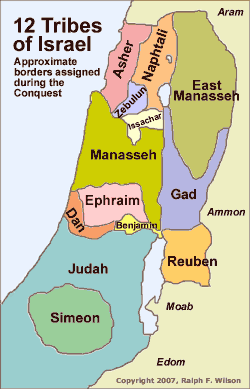
This is a map of the boundaries for the Promised Land in the reading today. There is some correspondence. But the modern day one seems more North-South pointy than the biblical one. "North-South pointy" is a technical term I just made up. The pictures on the right is from this website. The picture on the left is from this website. It is interesting to me to see what God promised them in the Bible compared to what the Israeli state possesses now. I know that the land that is now within the state of Israel was essentially taken from the Arabs living there in 1948, and I also know that since then, there has been nothing but conflict for those in Israel. It is still interesting to me to see these two maps.
There is mention of an "avenger of blood" in chapter 35. It seems that whenever a murder happened, there would be a person called the avenger of blood who would hunt down the guilty person. I do not know if this was a privately hired hit by the family of the deceased or a government issued thing. It is certainly the first time I have ever read about it, so I have a feeling this was a cultural development rather than a position ordained by God. The only way to escape the revenge of the avenger, was to seek out a city of refuge, which were predesignated towns within the territory of Israel. When the pursued got there, he was given a trial by assembly. The assembly was to hear the testimony of witnesses and decide the fate of the accused. If there was only one testimony, he was not killed, but if they were convinced by more than one testimony, then he was executed. It seems that God used this process and in a way commandeered the avenger of blood as a sort of precursor to the judge in Judges. In Numbers 35:1 it says, "The LORD said to Moses..." and then in verse 21, it says, "The avenger of blood shall put the murderer to death when he meets him." So, it seems that God condoned the practice.
Then I learned that it women and girls possibly owned land, because of Zelophod's daughters' case before Moses, and approved by God. In Numbers 36:8, it says, "Every daughter who inherits land in any Israelite tribe must marry someone in her father's tribal clan, so that every Israelite will possess the inheritance of his fathers." So, they could own land. Cool. Hooray for the development of women's rights!
Today began the reading of Deuteronomy, which is quite literally the famous last words of Moses to his people, where he summarizes their theological journey and law. I know that I have mentioned the theme of fear many times before. The fear of the LORD, the terror of God have been themes that have repeated themselves over and over. God's power is such that when we come face to face with it, dread sets in.
Deuteronomy is the first book so far that has many phrases like, "Do not be afraid..." "Do not be afraid of any man, for judgment belongs to God" (Deut. 1:17). "See, the LORD your God has given you the land. Go up and take possession of it as the LORD, the God of your fathers, told you. Do not be afraid; do not be discouraged" (Deut. 1:21). "Then I said to you, 'Do not be terrified; do not be afraid of them. The LORD you gGod, who is going before you, will fight for you, as he did fo ryou in Egypt, before your very eyes, and in the desert" (Deut. 1:29-30). So many times before, God told them to fear him. Now, though, God shows them that, when any nation is faced with the sheer power and presence of God, any nation will be brought to its knees. God is to be feared and terrified, yes, but when he is fighting and watching out for you, who else should they fear and love? The very one who terrifies us, loves us. If he is for us, who or what could be against us?
This reminds me of Romans 8:38-39, when Paul writes, "For I am convinced that neither death, nor life, nor angels, nor heavenly rulers, nor things that are present, nor things to come, nor powers, nor height, nor depth, nor anything else in creation will be able to separate us from the love of God in Christ Jesus our Lord." Amen to that.
1702 pages to go!
Sunday, October 31, 2010
Day 40: Numbers 30:1-33:56
To be honest, this was a hard passage for me to read. The first section contains regulations about vows, and it includes a lot of extremely patriarchal and sexist views towards the self-determination of women. After this, there is a section where the Israelites exact revenge on the Midianites (according to the LORD's command). After that, they split the spoils. Some tribes do not want to cross the Jordan into the Promised Land because the land looks so good, and therefore, the LORD is displeased with them. Then there is a final account of the sequence of locations that the Jews passed through in their journey from Egypt to the Promised Land.
In the first section on vows, a lot of the discussion is how a man can override any of his wife's vows if he hears about it. I know that this was written in a different time and culture, but to me, an institutional discrimination and patronization of women is moral reprehensible no matter how happy they are regardless. Chapter 30:5, 8, and 12 all talk about how a man can nullify his wife's or daughter's vow. It does not specify what these vows are. I would be curious to know, and if any of my readers- that's you, Tom- know what those vows are.
Chapter 31 starts with God's command to wipe out the Midianites, enemies of Israel. The Midianites seduced Israel into sexual immorality (in all its forms, presumably) and idolatry (to Baal [tne God of] of Peor, some kind of idol/false god). How do I know these fine details? Well, I look to the notes in my study Bible for these sorts of things. So, the Midianite were stealing Israel away from God and his divine love and justice. So, God commanded that they be wiped out. The Israelites killed them all except the women and children, who they took as plunder. Balaam, the guy who talked to the donkey a couple of chapters back, was killed in this attack.. Then they kill all of the male children (Num. 31:17), but keep for themselves all of the virgin girls. That bothers me.
They divy up the plunder and then head on out. As they reach the Jordan, the last and final barrier between them and the Promised Land, the Reubanites and Gadites see all of the range land and how it would be really good for their flocks and herds. So, they do not want to cross into the Promised Land because the good land is already there. They ask if they can stay there to have that land for their herds and flocks instead of having the portion of the Promised Land. Here it says that the LORD's anger was aroused. He reminded them that their forefathers did the same thing sometime ago, "...when [the LORD] sent them from Kadesh Barnea to look over the land. After they went up to the Valley of Eshcol and viewed the land, they discouraged the Israelites from entering the land the LORD had given them" (Num. 32:8-9). As a result, their forefathers wandered the desert for 40 years.
I think God was trying to remind the Reubanites and Gadites, in lieu of their greed and lack of faith, how horribly things went when their ancestors did the same thing. It turned out very bad. So, they finally say that they will go into the Promised Land, Canaan, with the rest of Israel, if, when the land is given to the people, they can have the land that they want. I get the sense from the context, after having just read about how bad things went the last time the Israelite tribes fared when they abandoned the LORD's providence, that history did not favour even this final act by the Reubanites and Gadites.
The next chapter is a brief synopsis of the waypoints along the journey from captivity in Egypt all the way to Canaan.Although I do not have a map, I have a feeling that much of this time was spent going around in circles or crossing over paths they had already tread. It seems like the whole thing was an object lesson that without the direction of God in our lives, we are just spinning in circles without hope. We are utterly hopeless without him.
I know that firsthand. Just think about it. I have no control over whether my heart beats. Everything I have, every beat of my heart is a gift. May I never forget that. When I realize that, I am afraid. There is no way I have any control over my heart beat. I am nothing without Him. God's overwhelming, pervasive, and unmatched power to me is as a sea storm to a leaf upon those crashing waves. This video does a better job explaining it. The most striking line, is when Chan alludes to when God says, "You want to challenge me? Why don't you stand up right now and tell everyone, 'Hey, I could live without you.'" The sheer thought of that terrifies me because I know I am nothing without him, and to lose the only hope I have through him would render this life meaningless, a chasing after the wind.
Thank God for Jesus Christ.
Only 1711 pages to go!
In the first section on vows, a lot of the discussion is how a man can override any of his wife's vows if he hears about it. I know that this was written in a different time and culture, but to me, an institutional discrimination and patronization of women is moral reprehensible no matter how happy they are regardless. Chapter 30:5, 8, and 12 all talk about how a man can nullify his wife's or daughter's vow. It does not specify what these vows are. I would be curious to know, and if any of my readers- that's you, Tom- know what those vows are.
Chapter 31 starts with God's command to wipe out the Midianites, enemies of Israel. The Midianites seduced Israel into sexual immorality (in all its forms, presumably) and idolatry (to Baal [tne God of] of Peor, some kind of idol/false god). How do I know these fine details? Well, I look to the notes in my study Bible for these sorts of things. So, the Midianite were stealing Israel away from God and his divine love and justice. So, God commanded that they be wiped out. The Israelites killed them all except the women and children, who they took as plunder. Balaam, the guy who talked to the donkey a couple of chapters back, was killed in this attack.. Then they kill all of the male children (Num. 31:17), but keep for themselves all of the virgin girls. That bothers me.
They divy up the plunder and then head on out. As they reach the Jordan, the last and final barrier between them and the Promised Land, the Reubanites and Gadites see all of the range land and how it would be really good for their flocks and herds. So, they do not want to cross into the Promised Land because the good land is already there. They ask if they can stay there to have that land for their herds and flocks instead of having the portion of the Promised Land. Here it says that the LORD's anger was aroused. He reminded them that their forefathers did the same thing sometime ago, "...when [the LORD] sent them from Kadesh Barnea to look over the land. After they went up to the Valley of Eshcol and viewed the land, they discouraged the Israelites from entering the land the LORD had given them" (Num. 32:8-9). As a result, their forefathers wandered the desert for 40 years.
I think God was trying to remind the Reubanites and Gadites, in lieu of their greed and lack of faith, how horribly things went when their ancestors did the same thing. It turned out very bad. So, they finally say that they will go into the Promised Land, Canaan, with the rest of Israel, if, when the land is given to the people, they can have the land that they want. I get the sense from the context, after having just read about how bad things went the last time the Israelite tribes fared when they abandoned the LORD's providence, that history did not favour even this final act by the Reubanites and Gadites.
The next chapter is a brief synopsis of the waypoints along the journey from captivity in Egypt all the way to Canaan.Although I do not have a map, I have a feeling that much of this time was spent going around in circles or crossing over paths they had already tread. It seems like the whole thing was an object lesson that without the direction of God in our lives, we are just spinning in circles without hope. We are utterly hopeless without him.
I know that firsthand. Just think about it. I have no control over whether my heart beats. Everything I have, every beat of my heart is a gift. May I never forget that. When I realize that, I am afraid. There is no way I have any control over my heart beat. I am nothing without Him. God's overwhelming, pervasive, and unmatched power to me is as a sea storm to a leaf upon those crashing waves. This video does a better job explaining it. The most striking line, is when Chan alludes to when God says, "You want to challenge me? Why don't you stand up right now and tell everyone, 'Hey, I could live without you.'" The sheer thought of that terrifies me because I know I am nothing without him, and to lose the only hope I have through him would render this life meaningless, a chasing after the wind.
Thank God for Jesus Christ.
Only 1711 pages to go!
Thursday, October 28, 2010
Days 38-39: Numbers 21:1-29:40
Because I have fallen a bit behind in my readings lately, I will do a two-for-one deal on today's blog. I would normally do a blog for each reading, but today, because I am tired and had a bit of two-day-long Monday in the middle of my week, this blog will be an abbreviated version.
Chapter 21 contains an intriguing passage of Scripture where God sends venomous snakes to the Israelites to discipline them because they started to speak out against Him and Moses, growing ever impatient with God's ways and timing. The snakes were awful and the people soon learned their lesson, and they cried out to God for help. So, God told Moses to fashion a bronze snake and to put it up on a pole. "Then when anyone who was bitten by a snake and looked at the bronze snake, he lived" (Num. 21:9). God disciplined His people, but once they turned back to Him, He provided for them relief and salvation from their affliction. I wonder why, when God said in Exodus to not fashion idols, He would use such an idol-like method of healing from the snakes.
Chapter 22 contains the story of how God used a pagan prophet, Balaam to save His people. Apparently, there was this foul tempered king named Balak, and he had it out for the Israelites, as did most kings in this time, I am learning. So, he summoned Balaam to curse Israel, but then God intervenes. God tells Balaam not to curse Israel, but to bless them. For some reason, this pagan Balaam says, "I could not do anything great or small to go beyond the command of the LORD my God." God moved in Balaam, and Balaam allowed himself to be moved.
As he was riding his donkey to go, God sent an angel with a drawn sword to prevent him from leaving. God was not impressed that Balaam would just get up and go. The angel stood in front of the donkey, and the donkey veered off course because it saw the angel, but Balaam did not see it. So, after beating the donkey without mercy three times, the donkey turns to Balaam and says, "What have I done to you to make you beat me these three times" (Num. 22:28). Without hesitation, Balaam talks back to his donkey... what a sight to see. The angel finally appears to Balaam, and Balaam falls face down on the ground. I would be terrified. After meeting God on the road, Balaam seems to change to become God's messenger himself to Balak.
Balak wants Balaam to curse Israel, but instead ends up blessing Israel four to seven times. I love one of the lines of his blessing. "Let me die the death of the righteous" (Num. 23:10). To rest in the place where God craves for me to be; that is what that phrase says to me. Another beautiful sort of blessing is in Numbers 24:9, "May those who bless you be blessed and those who curse you be cursed!" I like that for some reason. Then in Numbers 24:17, I think he pulls out a two-for-one special on prophecy. He seems to be foretelling the coming of David and Christ when he says, "A star will come out of Jacob; a scepter will rise out of Israel." Cool.
After all that, Israel still turns away from God, which makes the LORD very angry. He is so angry that those who turn away from Him are killed by an unspecified plague. It says, "The LORD's anger burned against them" (Num. 25:3), and then, "... the LORD's fierce anger..." (Num. 25:4). God certainly does not seem to tolerate insolence and profanity (the opposite of the sacred). It angers Him... big time. I am learning that holiness, "set-apart-ness", and righteousness are things that God thirsts and burns for.
After the events in the desert and all their wandering around, the Israelites do a nationwide head count. That amounts to lots of passages like this, "The descendants of Asher by their clans were: through Imnah, the Imnite clan; through Ishvi, the Ishvite clan; through Beriah, the Beriite clan; and through the descendants of Beriah: through Heber, the Heberite clan; through Malkiel, the Malkielte clan. (Asher had a daughter named Serah.) These were the clans of Asher; those numbered were 53, 400." At least they were thorough!
The last cool part of this passage was the commission of Joshua. This was a monumental point in Israel's history. The leader of Israel in one of their most historically rich and meaningful times of history, and a sort of Bible favourite, the man who (as tradition holds) wrote the Pentateuch, he was finally relinquishing his place as leader of the Jews and passing it on to the next generation. Joshua was to be the next leader of Israel.
And so the story continues! I look forward to tomorrow's reading when I am finally back on track and up to date with the readings and blogs. God bless!
Only 1716 pages more to go!
Chapter 21 contains an intriguing passage of Scripture where God sends venomous snakes to the Israelites to discipline them because they started to speak out against Him and Moses, growing ever impatient with God's ways and timing. The snakes were awful and the people soon learned their lesson, and they cried out to God for help. So, God told Moses to fashion a bronze snake and to put it up on a pole. "Then when anyone who was bitten by a snake and looked at the bronze snake, he lived" (Num. 21:9). God disciplined His people, but once they turned back to Him, He provided for them relief and salvation from their affliction. I wonder why, when God said in Exodus to not fashion idols, He would use such an idol-like method of healing from the snakes.
Chapter 22 contains the story of how God used a pagan prophet, Balaam to save His people. Apparently, there was this foul tempered king named Balak, and he had it out for the Israelites, as did most kings in this time, I am learning. So, he summoned Balaam to curse Israel, but then God intervenes. God tells Balaam not to curse Israel, but to bless them. For some reason, this pagan Balaam says, "I could not do anything great or small to go beyond the command of the LORD my God." God moved in Balaam, and Balaam allowed himself to be moved.
As he was riding his donkey to go, God sent an angel with a drawn sword to prevent him from leaving. God was not impressed that Balaam would just get up and go. The angel stood in front of the donkey, and the donkey veered off course because it saw the angel, but Balaam did not see it. So, after beating the donkey without mercy three times, the donkey turns to Balaam and says, "What have I done to you to make you beat me these three times" (Num. 22:28). Without hesitation, Balaam talks back to his donkey... what a sight to see. The angel finally appears to Balaam, and Balaam falls face down on the ground. I would be terrified. After meeting God on the road, Balaam seems to change to become God's messenger himself to Balak.
Balak wants Balaam to curse Israel, but instead ends up blessing Israel four to seven times. I love one of the lines of his blessing. "Let me die the death of the righteous" (Num. 23:10). To rest in the place where God craves for me to be; that is what that phrase says to me. Another beautiful sort of blessing is in Numbers 24:9, "May those who bless you be blessed and those who curse you be cursed!" I like that for some reason. Then in Numbers 24:17, I think he pulls out a two-for-one special on prophecy. He seems to be foretelling the coming of David and Christ when he says, "A star will come out of Jacob; a scepter will rise out of Israel." Cool.
After all that, Israel still turns away from God, which makes the LORD very angry. He is so angry that those who turn away from Him are killed by an unspecified plague. It says, "The LORD's anger burned against them" (Num. 25:3), and then, "... the LORD's fierce anger..." (Num. 25:4). God certainly does not seem to tolerate insolence and profanity (the opposite of the sacred). It angers Him... big time. I am learning that holiness, "set-apart-ness", and righteousness are things that God thirsts and burns for.
After the events in the desert and all their wandering around, the Israelites do a nationwide head count. That amounts to lots of passages like this, "The descendants of Asher by their clans were: through Imnah, the Imnite clan; through Ishvi, the Ishvite clan; through Beriah, the Beriite clan; and through the descendants of Beriah: through Heber, the Heberite clan; through Malkiel, the Malkielte clan. (Asher had a daughter named Serah.) These were the clans of Asher; those numbered were 53, 400." At least they were thorough!
The last cool part of this passage was the commission of Joshua. This was a monumental point in Israel's history. The leader of Israel in one of their most historically rich and meaningful times of history, and a sort of Bible favourite, the man who (as tradition holds) wrote the Pentateuch, he was finally relinquishing his place as leader of the Jews and passing it on to the next generation. Joshua was to be the next leader of Israel.
And so the story continues! I look forward to tomorrow's reading when I am finally back on track and up to date with the readings and blogs. God bless!
Only 1716 pages more to go!
Tuesday, October 26, 2010
Day 37: Numbers 16:1-20:29
There was a lot of judgment in today's reading. First people are swallowed into the earth when it splits open. Then they are burned as the LORD's fire consumes them. Then, Aaron and Moses are forbidden to enter the Promised Land.
Some people get envious and suspicious of Moses because he is essentially the highest authority (short of God) in the entire nation of Israel. These people were not just village idiots. It there were these main guys (Korah, Dathan, Abriam, and On). With them were 250 of Israel's elite and well-known men. They are suspicious of the priesthood who have exclusive access to God in His purest sense. They argued that all of Israel is holy, set apart to God, and therefore everyone should be involved with and have access to God (Num. 16:3). I could sense, though, that they did not really mean everyone. They probably wanted access to God themselves, and everyone else could fend for themselves. They are ready to storm the Tabernacle, but Moses makes a wager, saying that they should bring bronze torches with incense in them, and to stand before the Tabernacle opposite Moses and Aaron and Aaron's sons. Then, they would let God decide the outcome. If God was a God of (their flawed) reason, He would side with them. Right?
Moses is scared, because he could very well be killed by either God or these angry, envious men. In 16:22, he begs God not to judge the whole nation because of these few sinful men, but God reassures him.
Well, the "elites" show up with their incense, and Moses says that whoever God chooses will live. As soon as he says that, the earth splits open and all of the households of Korah, Daman, Abriam, and On fall into the pit, torches and all, and the earth closes over them. It reminded me of how the waters swallowed up the Egyptians in the Exodus. I wonder if that parallel was intentional. Anyway, these insurrection leaders are swallowed up. I am sure that their 250 elite friends were a little afraid at this point. They sure feared the LORD in that moment, I'm sure. They were afraid they were going to fall into the pit too (16:34), but God has something more dramatic in store. He sends fire that consumes them all.
Remember those bronze torches they had? Well, they did not burn up in the fire, obviously. So, God commands the priests to collect the bronze torches, hammer them out, and make a bronze covering for the altar. This was to "remind the Israelites that no one except a descendant of Aaron should come to burn incense before the LORD..." (Num. 16:36-40). How's that for an object lesson? Take the symbol of their pride from around the ashes of their burned bodies, and then use it in humble worship of the God they were trying to gain self-interested access to.
I got a real sense, in reading this, that God craves righteousness. He does not want our good intentions and half-hearted attempts. He wants us completely.
.I think the camp was bickering about who should lead the Israelites, to make it perfectly clear, after the upheaval of the past few days, who was to lead the Israelites. God tells them to take the walking stick from the leader of every tribe, 12 in total, and place them with their respective names in front of the Testimony to be left overnight. Whichever one sprouted would indicate which person was to lead Israel in worship. The next day, they saw that Aaron's staff had sprouted. They took this and placed it with the tablets and the manna in the Ark. I assume that was the same staff that turned into a snake. Cool staff.
There was a cool passage in this chapter 19 about the water of cleansing, which was a mix of the ashes of a burnt offering and water. The mixture was used in the purification of sin. The water was poured over the sinner on the third and seventh days, and then they were cleansed from their sin. What a powerful symbol. You were washed clean by the death of a sacrifice. Its ground bones flowed over your skin, covering you from the wrath of God, and washing you clean from your impurity.
Chapter 20 contains another passage about water from a rock. This is a direct parallel to Exodus 17. The people complain about not having water to drink, so Moses goes to God. God tells him to speak to the rock, and it would pour out water. Moses walked in front of the people, and got upset, probably because of the all the recent events. He called them "rebels" (Num. 20:10). He struck the rock with his staff, just like he did in Exodus 17, and the water gushed out. But he had disobeyed God's commands, and he had acted out of anger. As a result, God tells Moses that he nor Aaron would enter the Promised Land (Num. 20:12). God craves holiness, righteousness, and attention to detail.
The last passage of this chapter contains the story of Aaron's death. He was to walk to the top of Mount Hor, remove his priestly garments, pass them onto his son, and them die. He did as the LORD commanded. He died in a final act of obedience. I just got a real chill of reverence as I read that passage. It seemed so surreal and holy.
1730 pages to go!
Some people get envious and suspicious of Moses because he is essentially the highest authority (short of God) in the entire nation of Israel. These people were not just village idiots. It there were these main guys (Korah, Dathan, Abriam, and On). With them were 250 of Israel's elite and well-known men. They are suspicious of the priesthood who have exclusive access to God in His purest sense. They argued that all of Israel is holy, set apart to God, and therefore everyone should be involved with and have access to God (Num. 16:3). I could sense, though, that they did not really mean everyone. They probably wanted access to God themselves, and everyone else could fend for themselves. They are ready to storm the Tabernacle, but Moses makes a wager, saying that they should bring bronze torches with incense in them, and to stand before the Tabernacle opposite Moses and Aaron and Aaron's sons. Then, they would let God decide the outcome. If God was a God of (their flawed) reason, He would side with them. Right?
Moses is scared, because he could very well be killed by either God or these angry, envious men. In 16:22, he begs God not to judge the whole nation because of these few sinful men, but God reassures him.
Well, the "elites" show up with their incense, and Moses says that whoever God chooses will live. As soon as he says that, the earth splits open and all of the households of Korah, Daman, Abriam, and On fall into the pit, torches and all, and the earth closes over them. It reminded me of how the waters swallowed up the Egyptians in the Exodus. I wonder if that parallel was intentional. Anyway, these insurrection leaders are swallowed up. I am sure that their 250 elite friends were a little afraid at this point. They sure feared the LORD in that moment, I'm sure. They were afraid they were going to fall into the pit too (16:34), but God has something more dramatic in store. He sends fire that consumes them all.
Remember those bronze torches they had? Well, they did not burn up in the fire, obviously. So, God commands the priests to collect the bronze torches, hammer them out, and make a bronze covering for the altar. This was to "remind the Israelites that no one except a descendant of Aaron should come to burn incense before the LORD..." (Num. 16:36-40). How's that for an object lesson? Take the symbol of their pride from around the ashes of their burned bodies, and then use it in humble worship of the God they were trying to gain self-interested access to.
I got a real sense, in reading this, that God craves righteousness. He does not want our good intentions and half-hearted attempts. He wants us completely.
.I think the camp was bickering about who should lead the Israelites, to make it perfectly clear, after the upheaval of the past few days, who was to lead the Israelites. God tells them to take the walking stick from the leader of every tribe, 12 in total, and place them with their respective names in front of the Testimony to be left overnight. Whichever one sprouted would indicate which person was to lead Israel in worship. The next day, they saw that Aaron's staff had sprouted. They took this and placed it with the tablets and the manna in the Ark. I assume that was the same staff that turned into a snake. Cool staff.
There was a cool passage in this chapter 19 about the water of cleansing, which was a mix of the ashes of a burnt offering and water. The mixture was used in the purification of sin. The water was poured over the sinner on the third and seventh days, and then they were cleansed from their sin. What a powerful symbol. You were washed clean by the death of a sacrifice. Its ground bones flowed over your skin, covering you from the wrath of God, and washing you clean from your impurity.
Chapter 20 contains another passage about water from a rock. This is a direct parallel to Exodus 17. The people complain about not having water to drink, so Moses goes to God. God tells him to speak to the rock, and it would pour out water. Moses walked in front of the people, and got upset, probably because of the all the recent events. He called them "rebels" (Num. 20:10). He struck the rock with his staff, just like he did in Exodus 17, and the water gushed out. But he had disobeyed God's commands, and he had acted out of anger. As a result, God tells Moses that he nor Aaron would enter the Promised Land (Num. 20:12). God craves holiness, righteousness, and attention to detail.
The last passage of this chapter contains the story of Aaron's death. He was to walk to the top of Mount Hor, remove his priestly garments, pass them onto his son, and them die. He did as the LORD commanded. He died in a final act of obedience. I just got a real chill of reverence as I read that passage. It seemed so surreal and holy.
1730 pages to go!
Monday, October 25, 2010
Day 36: Numbers 11:1-15:41
The Tabernacle was now completed. The Israelites were leaving Sinai. They had just spent the last four or five chapters following the LORD's commands wholeheartedly, and then in chapter 11, they start complaining about their hardships.
God's awesome presentation is another theme in this reading. When God heard their complaining, he "burned" with anger. He sent fire to burn among them. This fire burned and consumed the outskirts of the camp (Num. 11:1). I know I would be terrified to see such a thing happen. It would be like Hell burning all around me. Consuming Hell fire would surround me. I would be terrified.
God seems to use fire as an object lesson to represent himself throughout the Scripture I have read so far. He comes as a pillar of fire at night to lead and watch over the people of Israel. I imagine that in the good times, this was a comfort... the Divine Nightlight. It would remind me of his faithfulness in leading me out of the land of bondage. But now, I would be terrified. I would be surrounded by flame, confusion, and death. It is no wonder "the people cried out to Moses" (Ex. 11: 2). Again, God presents himself as a terrifying force, one that instills fear and trembling, not just reverence.
After this experience, they complain saying that they want meat to eat, not just flatbread manna. So, in a way reminiscent of Dante's Inferno, where sins are punished through ironic suffering, God sends quail in quantities enough to sicken even the most true gluttons. They must eat quail "... for a whole month-until it comes out of [their] nostrils and [they] loathe it-because [they] have rejected the LORD..." In Dante's Inferno sinners were punished according to their sins. For example, those who caused division in the church (schism) were forced for eternity to be cut open and then walk in a circle until they healed up again, where they would be sliced again once they got back to the start of the circle again. Here, the people complained to God, not being thankful for the blessings they had. So God overwhelmed them with what they wanted to the point of sickness. This story serves as a cogent reminder that God will provide what we need and we ought not complain when our needs are met, but rather be thankful for every thread of clothing, every crumb of food, and every drop of water.
Well, that was all I had to say about today's reading. Only 1736 pages to go!
God's awesome presentation is another theme in this reading. When God heard their complaining, he "burned" with anger. He sent fire to burn among them. This fire burned and consumed the outskirts of the camp (Num. 11:1). I know I would be terrified to see such a thing happen. It would be like Hell burning all around me. Consuming Hell fire would surround me. I would be terrified.
God seems to use fire as an object lesson to represent himself throughout the Scripture I have read so far. He comes as a pillar of fire at night to lead and watch over the people of Israel. I imagine that in the good times, this was a comfort... the Divine Nightlight. It would remind me of his faithfulness in leading me out of the land of bondage. But now, I would be terrified. I would be surrounded by flame, confusion, and death. It is no wonder "the people cried out to Moses" (Ex. 11: 2). Again, God presents himself as a terrifying force, one that instills fear and trembling, not just reverence.
After this experience, they complain saying that they want meat to eat, not just flatbread manna. So, in a way reminiscent of Dante's Inferno, where sins are punished through ironic suffering, God sends quail in quantities enough to sicken even the most true gluttons. They must eat quail "... for a whole month-until it comes out of [their] nostrils and [they] loathe it-because [they] have rejected the LORD..." In Dante's Inferno sinners were punished according to their sins. For example, those who caused division in the church (schism) were forced for eternity to be cut open and then walk in a circle until they healed up again, where they would be sliced again once they got back to the start of the circle again. Here, the people complained to God, not being thankful for the blessings they had. So God overwhelmed them with what they wanted to the point of sickness. This story serves as a cogent reminder that God will provide what we need and we ought not complain when our needs are met, but rather be thankful for every thread of clothing, every crumb of food, and every drop of water.
Well, that was all I had to say about today's reading. Only 1736 pages to go!
Friday, October 22, 2010
Days 32 and 33- Numbers 3:1-6:27, 7:1-10:36
I have fallen behind in my reading, and there was a lot of content. Most of it centred around the Tabernacle; who was to carry what, the ceremony for its sanctification, etc.
I am very tired and there is much too much detail to go into for tonight.
This section of Scripture has one of my favourite passages, though. It is a blessing that Aaron gave to the people of Israel. I love this blessing, and it is one of the most moving passages of Scripture.
Numbers 6:24-26, the Priestly Blessing, "The LORD bless you and keep you; the LORD make his face to shine upon you and be gracious to you; the LORD turn his face toward you and give you peace."
I try to imagine that Christ Himself is saying it to me. What is interesting to me is that so often, anyone who looks at the face of God is struck dead. No one was allowed to enter the presence of God unless they were absolutely blameless as per all of the regulations. I have seen many references to the fear, the dread, the terror of God. Clearly, God presents himself as utter power, holiness, beauty, sacred presence.
I am tired tonight. Hopefully, I will sleep well.
I am very tired and there is much too much detail to go into for tonight.
This section of Scripture has one of my favourite passages, though. It is a blessing that Aaron gave to the people of Israel. I love this blessing, and it is one of the most moving passages of Scripture.
Numbers 6:24-26, the Priestly Blessing, "The LORD bless you and keep you; the LORD make his face to shine upon you and be gracious to you; the LORD turn his face toward you and give you peace."
I try to imagine that Christ Himself is saying it to me. What is interesting to me is that so often, anyone who looks at the face of God is struck dead. No one was allowed to enter the presence of God unless they were absolutely blameless as per all of the regulations. I have seen many references to the fear, the dread, the terror of God. Clearly, God presents himself as utter power, holiness, beauty, sacred presence.
I am tired tonight. Hopefully, I will sleep well.
Wednesday, October 20, 2010
Day 31: Leviticus 26:1-Numbers 2:34
I finished Leviticus today!
In the last two chapters of Leviticus, God tells the Israelites of the reward for obedience and the punishment for disobedience. After giving them all of his laws, God now gives them the final contingencies of his plans for them. Essentially, the blessing is of abundance, peace in the land, fertility, and prosperity- essentially a "name", the same covenant made with Abraham and his descendants. The punishment is the opposite of this covenant blessing: disease, famine, God's rejection, death and infertility, conflict and death. Then God says to Israel, in Lev. 26:29, "You will eat the flesh of your sons and the flesh of your daughters." I am a little confused and disturbed by this. I read Dante's Inferno last year, and the eating of cannibalism of one's children reminds me of Dante's allegorical use of the character Ugolino in the frozen river of hell, Cocytus, where Ugolino gnaws at the head of Ruggieri for eternity. Ruggieri in life, had locked Ugolino with his children into his tower in the Muda. There his children died of starvation, and after their death and because of his hunger and madness, he ate his children to survive. That empty madness is what I thought of when I read that passage.
Leviticus ends with the phrase, "These are the commands the LORD gave Moses on Mount Sinai for the Israelites."
Numbers is a whole new ball game for me. I am not looking forward to reading this book. My impression is that it a huge, repetitive list of hard-to-pronounce names and very little plot. So far, I am afraid that my fears have been confirmed. Of interest, in each tribe of Israel, God appoints one man to take a census of that tribe and then lead that tribe. They are Elizur, Shelumiel, Nahshon, Nethanel, Eliab, Elishama, Gamaliel, Abidan, Ahiezer, Pagiel, Eliasaph, and Ahira. According to my study Bible, most of these names contain reference to God. I think probably the prefix, Eli-, and the suffix -iel, is what it was referring to. So, these men represented God among the tribes... could be one interpretation. Then there is a repetitive list of names and populations, and the instructions for the layout of the camp.
Hopefully, I will have more interesting stuff tomorrow. Thank the Lord I am still able to keep up with my reading and continue on learning about Him.
1760 pages to go!
In the last two chapters of Leviticus, God tells the Israelites of the reward for obedience and the punishment for disobedience. After giving them all of his laws, God now gives them the final contingencies of his plans for them. Essentially, the blessing is of abundance, peace in the land, fertility, and prosperity- essentially a "name", the same covenant made with Abraham and his descendants. The punishment is the opposite of this covenant blessing: disease, famine, God's rejection, death and infertility, conflict and death. Then God says to Israel, in Lev. 26:29, "You will eat the flesh of your sons and the flesh of your daughters." I am a little confused and disturbed by this. I read Dante's Inferno last year, and the eating of cannibalism of one's children reminds me of Dante's allegorical use of the character Ugolino in the frozen river of hell, Cocytus, where Ugolino gnaws at the head of Ruggieri for eternity. Ruggieri in life, had locked Ugolino with his children into his tower in the Muda. There his children died of starvation, and after their death and because of his hunger and madness, he ate his children to survive. That empty madness is what I thought of when I read that passage.
Leviticus ends with the phrase, "These are the commands the LORD gave Moses on Mount Sinai for the Israelites."
Numbers is a whole new ball game for me. I am not looking forward to reading this book. My impression is that it a huge, repetitive list of hard-to-pronounce names and very little plot. So far, I am afraid that my fears have been confirmed. Of interest, in each tribe of Israel, God appoints one man to take a census of that tribe and then lead that tribe. They are Elizur, Shelumiel, Nahshon, Nethanel, Eliab, Elishama, Gamaliel, Abidan, Ahiezer, Pagiel, Eliasaph, and Ahira. According to my study Bible, most of these names contain reference to God. I think probably the prefix, Eli-, and the suffix -iel, is what it was referring to. So, these men represented God among the tribes... could be one interpretation. Then there is a repetitive list of names and populations, and the instructions for the layout of the camp.
Hopefully, I will have more interesting stuff tomorrow. Thank the Lord I am still able to keep up with my reading and continue on learning about Him.
1760 pages to go!
Tuesday, October 19, 2010
Day 30: Leviticus 22:1-25:55
For the record, olive oil does not burn. I tried. Why do I start with these sentences? In chapter 24:1-2, the LORD tells Moses to "bring the clear oil of pressed olives for the light to that the lamps may be kept burning continually." So, being the good scientific person I am, I went up into the kitchen, grabbed myself some EVOO, poured it into a bowl, and brought the flame of my lighter to the oil. What was I hoping for? I think I was expecting a soft, blue flame to gently flow across the oil. What did I get? Nothing. Perhaps God did not have my particular olive oil in mind, or maybe the olive oil of those days was just more flammable.
Today's reading covered the LORD's commands regarding unacceptable sacrifices, the Sabbath, the Passover, the offering of the firstfruits of the harvest, the Feast of Weeks, the Feast of Trumpets, the Day of Atonement, the Feast of Tabernacles, the type of food to be set at the table before the LORD in the tabernacle, the story of a blasphemer who got stoned (like beaten to death with rocks, not baked) after making the sacred name of the LORD profane, and the Year of Jubilee regulations. There was a lot of stuff in this reading.
I was struck by how much celebrating has been commanded so far. I am sure more ceremonies are to be instituted as I read more, but I was struck at how often the whole community took time off to rest, celebrate, reflect on the way God worked in their lives, and look to him for forgiveness and favour.
There are a lot of ceremonies, but I want to focus on the Year of Jubilee. If I understand it correctly, it was like the ultimate wealth re-distribution procedure. In that year, all slaves were freed, all debts were canceled all land and possessions taken from people sold into slavery or servanthood was reinstated to the original owners. Many other social welfare practices are mandated. For example, Lev. 25:35-38 says, "If one of your countrymen becomes poor and is unable to support himself among you, help him as you would an alien or a temporary resident, so he can continue to live among you. Do not take interest of any kind from him, but fear your God, so that your country man may continue to live among you. You must not lend him money at interest or sell him food at a profit. I am the LORD your God, who brought you out of Egypt to give you the land of Canaan and to be your God." When I read this I thought that this was beautiful. It strikes me that not only is this a social welfare institution, but it also seems like an object lesson. When God says, "... but fear your God... I am the LORD your God, who brought you out of Egypt to give you the land of Canaan and to be your God", it seems to me like God was saying, "Only because I brought you out of slavery, cleared the land, and let you settle here, you have anything. So, remember that ultimately I own everything, and everything you own is a gift."
Again, the concept of the "fear" of the LORD came up today in the context of making sure that Israelites who owned slaves did not "treat them ruthlessly" (Lev. 25:43) and making sure that they did not "take advantage of each other" but to "fear [their] God" (Lev. 25:17). God says to fear Him, because, after all: Who had the power to wash death over Egypt, summon darkness for days, part seas and pull them together, etc.? It is is like God is reminding them of His absolute, incredible-ness, Much of what I'm trying to capture is shown in this video, called BASIC.Fear.
I feel like I am seeing a pattern develop where, through this Scripture, I am learning that if I actually met God, I would be terrified. I think I need to learn the lesson He is trying to teach me: that I am nothing before Him, but I mean everything to Him and that He is my only true hope, that, like He did for the Jews- He will provide for my life, and that I will have nothing in my life without His grace. I cannot even control my own heart beat or whether I will wake up tomorrow morning. Everything I am and have is a gift.
Who am I to boast?
Today's reading covered the LORD's commands regarding unacceptable sacrifices, the Sabbath, the Passover, the offering of the firstfruits of the harvest, the Feast of Weeks, the Feast of Trumpets, the Day of Atonement, the Feast of Tabernacles, the type of food to be set at the table before the LORD in the tabernacle, the story of a blasphemer who got stoned (like beaten to death with rocks, not baked) after making the sacred name of the LORD profane, and the Year of Jubilee regulations. There was a lot of stuff in this reading.
I was struck by how much celebrating has been commanded so far. I am sure more ceremonies are to be instituted as I read more, but I was struck at how often the whole community took time off to rest, celebrate, reflect on the way God worked in their lives, and look to him for forgiveness and favour.
There are a lot of ceremonies, but I want to focus on the Year of Jubilee. If I understand it correctly, it was like the ultimate wealth re-distribution procedure. In that year, all slaves were freed, all debts were canceled all land and possessions taken from people sold into slavery or servanthood was reinstated to the original owners. Many other social welfare practices are mandated. For example, Lev. 25:35-38 says, "If one of your countrymen becomes poor and is unable to support himself among you, help him as you would an alien or a temporary resident, so he can continue to live among you. Do not take interest of any kind from him, but fear your God, so that your country man may continue to live among you. You must not lend him money at interest or sell him food at a profit. I am the LORD your God, who brought you out of Egypt to give you the land of Canaan and to be your God." When I read this I thought that this was beautiful. It strikes me that not only is this a social welfare institution, but it also seems like an object lesson. When God says, "... but fear your God... I am the LORD your God, who brought you out of Egypt to give you the land of Canaan and to be your God", it seems to me like God was saying, "Only because I brought you out of slavery, cleared the land, and let you settle here, you have anything. So, remember that ultimately I own everything, and everything you own is a gift."
Again, the concept of the "fear" of the LORD came up today in the context of making sure that Israelites who owned slaves did not "treat them ruthlessly" (Lev. 25:43) and making sure that they did not "take advantage of each other" but to "fear [their] God" (Lev. 25:17). God says to fear Him, because, after all: Who had the power to wash death over Egypt, summon darkness for days, part seas and pull them together, etc.? It is is like God is reminding them of His absolute, incredible-ness, Much of what I'm trying to capture is shown in this video, called BASIC.Fear.
I feel like I am seeing a pattern develop where, through this Scripture, I am learning that if I actually met God, I would be terrified. I think I need to learn the lesson He is trying to teach me: that I am nothing before Him, but I mean everything to Him and that He is my only true hope, that, like He did for the Jews- He will provide for my life, and that I will have nothing in my life without His grace. I cannot even control my own heart beat or whether I will wake up tomorrow morning. Everything I am and have is a gift.
Who am I to boast?
Monday, October 18, 2010
Day 29: Leviticus 16:1-21:24
Holiness and sacredness seemed to be the main theme of the reading today.
There are a whole list of "do nots" in this section. I interpret this in two ways. Perhaps, when Moses was listening to God's instruction, he was commenting on the detestable things that the Israelites were doing around him. For example, when, chapter 18 verse 8, it says, "Do not have sexual relations with your father's wife; that would dishonor your father." I wondered if there was public knowledge that many men or women were sleeping with their father's wife (not necessarily their mother, because their father could have multiple wives).
Or maybe it was the result of something different. Based on the theme of holiness, maybe God was trying to set Israel as a whole apart from the other nations of the land. Perhaps the nations of the land were the ones mainly engaging in all of these sexual activities, practices, and rituals. These were all detestable to God.
It seems like the whole section is best summarized in what I thought was the key verses, Leviticus 20:7, 8 and Leviticus 21:6, 8. "Consecrate yourselves and be holy, because I am the LORD your God", "I am the LORD who makes you holy", "... must be holy to their God and must not profane the name of their God", "... because I the LORD am holy-I who make you holy."
The punishment for a lot of the sexual sins are death by stoning, except for the case of the girl who becomes a prostitute, because she must be burned to death. These rules sound to me like what sociologists and religious scholars call pollution laws governed by shame. The idea is that they are not so much rules of right and wrong that are governed by guilt. They do not seem like rules of whether an act adheres to a higher moral code. Usually these moral codes are governed by guilt. A person is guilty because they broke the moral code by action that was within their control but they chose to break it. It is the result of an internal, unstable, and controllable attribution made by the community and the person him/herself. Pollution laws are generally more primitive. They operate on the basis of shame. They are to separate people from "uncleanliness", whatever that group deems as unclean. They are often highly ritualized societies. The idea is to protect the sacred from the profane. The profane is anything that is unclean. Bodily fluids, menstrual blood, certain sexual acts, certain foods, etc. all can make profane that which is sacred. The some things are more out of a person's control than others (e.g., menstruation or nocturnal emissions are uncontrollable). The pollution laws are imposed on the individual. Generally, then, the individual is not in control, there is a sense of internal cause to the pollution, and the pollution may or may not be stable. This generally leads to the feeling of shame. It seems like the Leviticus are shaming laws that are based on pollution-type social mores. In order to make the profane once again sacred or the polluted clean again, many rituals are instituted. In this case, God used the symbol of the pouring of blood and death to redeem those who are guilty of sin, to forgive them. They are redeemed, made sacred again.
What is interesting to me is that Jesus flips this whole paradigm upside down in the New Testament when he turns these pollution regulations into a moral code by internalizing the whole thing. Suddenly, if you so much as hate another person, you have committed something equal to murder. The underlying message to me is that is an act that is internal, unstable, and controllable. Suddenly, you are no longer dealing with a pollution regulation system governed by shame, but a moral framework regulated by guilt.
Once we are guilty, though, thank the Lord that Christ came, because He is the only remedy to make me clean again. He was the final redeemer. Thank God all I have to do is turn my guilt to Him, fall to His feet, and when I ask, He forgives me. Every time. That is my only hope of holiness. The only thing in which I can boast: that I am forgiven through Christ.
There are a whole list of "do nots" in this section. I interpret this in two ways. Perhaps, when Moses was listening to God's instruction, he was commenting on the detestable things that the Israelites were doing around him. For example, when, chapter 18 verse 8, it says, "Do not have sexual relations with your father's wife; that would dishonor your father." I wondered if there was public knowledge that many men or women were sleeping with their father's wife (not necessarily their mother, because their father could have multiple wives).
Or maybe it was the result of something different. Based on the theme of holiness, maybe God was trying to set Israel as a whole apart from the other nations of the land. Perhaps the nations of the land were the ones mainly engaging in all of these sexual activities, practices, and rituals. These were all detestable to God.
It seems like the whole section is best summarized in what I thought was the key verses, Leviticus 20:7, 8 and Leviticus 21:6, 8. "Consecrate yourselves and be holy, because I am the LORD your God", "I am the LORD who makes you holy", "... must be holy to their God and must not profane the name of their God", "... because I the LORD am holy-I who make you holy."
The punishment for a lot of the sexual sins are death by stoning, except for the case of the girl who becomes a prostitute, because she must be burned to death. These rules sound to me like what sociologists and religious scholars call pollution laws governed by shame. The idea is that they are not so much rules of right and wrong that are governed by guilt. They do not seem like rules of whether an act adheres to a higher moral code. Usually these moral codes are governed by guilt. A person is guilty because they broke the moral code by action that was within their control but they chose to break it. It is the result of an internal, unstable, and controllable attribution made by the community and the person him/herself. Pollution laws are generally more primitive. They operate on the basis of shame. They are to separate people from "uncleanliness", whatever that group deems as unclean. They are often highly ritualized societies. The idea is to protect the sacred from the profane. The profane is anything that is unclean. Bodily fluids, menstrual blood, certain sexual acts, certain foods, etc. all can make profane that which is sacred. The some things are more out of a person's control than others (e.g., menstruation or nocturnal emissions are uncontrollable). The pollution laws are imposed on the individual. Generally, then, the individual is not in control, there is a sense of internal cause to the pollution, and the pollution may or may not be stable. This generally leads to the feeling of shame. It seems like the Leviticus are shaming laws that are based on pollution-type social mores. In order to make the profane once again sacred or the polluted clean again, many rituals are instituted. In this case, God used the symbol of the pouring of blood and death to redeem those who are guilty of sin, to forgive them. They are redeemed, made sacred again.
What is interesting to me is that Jesus flips this whole paradigm upside down in the New Testament when he turns these pollution regulations into a moral code by internalizing the whole thing. Suddenly, if you so much as hate another person, you have committed something equal to murder. The underlying message to me is that is an act that is internal, unstable, and controllable. Suddenly, you are no longer dealing with a pollution regulation system governed by shame, but a moral framework regulated by guilt.
Once we are guilty, though, thank the Lord that Christ came, because He is the only remedy to make me clean again. He was the final redeemer. Thank God all I have to do is turn my guilt to Him, fall to His feet, and when I ask, He forgives me. Every time. That is my only hope of holiness. The only thing in which I can boast: that I am forgiven through Christ.
Friday, October 15, 2010
Day 26: Leviticus 13:1-15:33
Today was a terrible day. I'm not really in a good mood, so this blog will be short.
This section of Scripture dealt primarily with cleanliness laws. It spells out the ways in which a person becomes unclean, the ramifications of uncleanliness, the remedies for uncleanliness, and how the person is reintegrated after being unclean.
I learned that you can become unclean through disease, the emission of bodily fluids and blood.
Wow, I am really unmotivated to blog anything else today. I think that it would be best if I wrapped it up for today and just let you know that I did read the reading for today.
This section of Scripture dealt primarily with cleanliness laws. It spells out the ways in which a person becomes unclean, the ramifications of uncleanliness, the remedies for uncleanliness, and how the person is reintegrated after being unclean.
I learned that you can become unclean through disease, the emission of bodily fluids and blood.
Wow, I am really unmotivated to blog anything else today. I think that it would be best if I wrapped it up for today and just let you know that I did read the reading for today.
Thursday, October 14, 2010
Day 25: Leviticus 8:1-12:8
Today's reading began with the ordination of Aaron and his sons, where they were set apart for the sole purpose of serving God on behalf of Israel. Just about every wave, fellowship, grain, guilt, and sin offering was made in the ceremony. I think the point of all of sacrifices and offerings was to make sure that Aaron and his sons were completely pure and holy before starting their service to God and the Israelites.
I think there is a second reason, as well. They had to go through just about every type of sacrifice and ceremony during the ordination. I wonder if this was a "dry run". God had just laid down all of the rules surrounding the purification of the people. I think this was the first time that they had attempted to do them all properly. It makes sense to me that they would go through every single ritual because they would want to make the consecration of their religious leaders a truly special event.
So, they went through their ceremony and there was stuff on the altar. At the end of Lev. 9, the priests come out and bless the people. The glory of the LORD appears. Then a fire "from the presence of the LORD" came and burned up all of the offerings. The people are overjoyed and worship with their faces down. Fire blazing from Heaven would be a sight to see.
After the all consuming fire from God at the end of chapter 9, chapter 10 starts with some "unauthorized fire" (Ex. 10:1). Aaron's sons put fire in some incense bowls and added incense to God, but for some reason this was not acceptable. So, the fire from the presence of the LORD came out and consumed the sons. God said that he would show himself holy and the people would honour him. What I find interesting is that in the next sentence, it says, "Aaron remained silent" (Ex. 10:3). Was this shock, horror, awe, disgust, or grief? I do not know. But I know that I would be speechless and wrenched with sorrow if my sons were killed like that. My study Bible says that a possible reason for the death of his sons is that God had to be harsh to teach the Israelites that they existed for his purposes, not the other way around. Somehow, though, it still bothers me.
After the ceremony and bad stuff, God tells them what is clean and unclean.
Split hoof + cud chewing = clean.
Not Split hoof + cud chewing = unclean.
Split hoof + not cud chewing = unclean.
If from the water, scales + fins = clean.
If from the water, not scales + fins = unclean.
If from the water, scales + not fins = unclean.
All bugs unclean except locusts, katydids, crickets, and grasshoppers.
I do not know if the clean/unclean rules were to protect desert nomads before the days of cooking thermometers, antibiotics, and other modern medicine stuff from the ravages of possible disease from potentially hazardous meat products. One of my professors once said that in Near East culture, pigs are revolted because their waste very easily seeps into water supplies and they forage through stuff. I do not know if that is the reason God instituted these precepts, though.
Sometimes, I wonder if many of these rules are just arbitrary and the whole set of them were designed as a test of how obedient a people would be. Exodus 11:44 said, "I am the LORD your God; consecrate yourselves and be holy , because I am holy." I wonder if the whole set of laws and regulations was to set a people apart from the rest of the society, to make life more complicated so they would have to rely on God for everything.
This is probably the earliest post to date. I could not sleep last night. I tossed and turned, and I did not feel at peace. So, I woke up and decided to read Scripture. I look forward to it everyday, now. It is my time alone with God where I can learn about him, ask him questions, fall at his feet and say that I do not understand it all, tell him I love him, and ask for his forgiveness. Lord knows, I need his forgiveness every day.
1790 pages to go.
I think there is a second reason, as well. They had to go through just about every type of sacrifice and ceremony during the ordination. I wonder if this was a "dry run". God had just laid down all of the rules surrounding the purification of the people. I think this was the first time that they had attempted to do them all properly. It makes sense to me that they would go through every single ritual because they would want to make the consecration of their religious leaders a truly special event.
So, they went through their ceremony and there was stuff on the altar. At the end of Lev. 9, the priests come out and bless the people. The glory of the LORD appears. Then a fire "from the presence of the LORD" came and burned up all of the offerings. The people are overjoyed and worship with their faces down. Fire blazing from Heaven would be a sight to see.
After the all consuming fire from God at the end of chapter 9, chapter 10 starts with some "unauthorized fire" (Ex. 10:1). Aaron's sons put fire in some incense bowls and added incense to God, but for some reason this was not acceptable. So, the fire from the presence of the LORD came out and consumed the sons. God said that he would show himself holy and the people would honour him. What I find interesting is that in the next sentence, it says, "Aaron remained silent" (Ex. 10:3). Was this shock, horror, awe, disgust, or grief? I do not know. But I know that I would be speechless and wrenched with sorrow if my sons were killed like that. My study Bible says that a possible reason for the death of his sons is that God had to be harsh to teach the Israelites that they existed for his purposes, not the other way around. Somehow, though, it still bothers me.
After the ceremony and bad stuff, God tells them what is clean and unclean.
Split hoof + cud chewing = clean.
Not Split hoof + cud chewing = unclean.
Split hoof + not cud chewing = unclean.
If from the water, scales + fins = clean.
If from the water, not scales + fins = unclean.
If from the water, scales + not fins = unclean.
All bugs unclean except locusts, katydids, crickets, and grasshoppers.
I do not know if the clean/unclean rules were to protect desert nomads before the days of cooking thermometers, antibiotics, and other modern medicine stuff from the ravages of possible disease from potentially hazardous meat products. One of my professors once said that in Near East culture, pigs are revolted because their waste very easily seeps into water supplies and they forage through stuff. I do not know if that is the reason God instituted these precepts, though.
Sometimes, I wonder if many of these rules are just arbitrary and the whole set of them were designed as a test of how obedient a people would be. Exodus 11:44 said, "I am the LORD your God; consecrate yourselves and be holy , because I am holy." I wonder if the whole set of laws and regulations was to set a people apart from the rest of the society, to make life more complicated so they would have to rely on God for everything.
This is probably the earliest post to date. I could not sleep last night. I tossed and turned, and I did not feel at peace. So, I woke up and decided to read Scripture. I look forward to it everyday, now. It is my time alone with God where I can learn about him, ask him questions, fall at his feet and say that I do not understand it all, tell him I love him, and ask for his forgiveness. Lord knows, I need his forgiveness every day.
1790 pages to go.
Wednesday, October 13, 2010
Day 24: Leviticus 2:1-7:38
Today, I read all about the different types of offerings that were to be made at the Tabernacle. The burnt offering, grain offering, fellowship offering, sin offering, and guilt offering. I learned, among other things, that the first three were designed more like offerings made as praise to God or to find favour in his eyes. The last two are specifically for atonement of sin committed by an individual, a leader, or the whole community.
This was the first section of Scripture that I came across the phrase, "... and (they/he) will be forgiven" (Starting in Lev. 4:20, 26, 31, and 35). Forgiveness is first mentioned in the context of the slaughter of animals and the pouring out of blood at the base of the altar and sprinkling of blood on the altar horns. Then the fat was burned on the alter. (I giggled at Ex. 3:16, "All the fat is the LORD's."). The animal was killed, broken, cut, torn apart, and then burnt. The death in the place of the person or people heralds forgiveness.
This leads me to the next interesting thing I learned. The animal death was a symbol of the person's death. Starting in the first chapter, people are told to place their hands on the head of the animal to be slaughtered. They have their hands on the animal's head as its throat is slit, it bleeds out, an it dies. According to my study Bible, the placing of the hands on the animal's head is to "express identification between [the person offering the animal] and the animal, whose death would then be accepted in 'atonement'". Symbolically, they are saying, "I must die to atone for the wrong things I have done. I must let my blood pour out, be parted and burned. Only then will I become pleasing to the LORD (Ex. 1:9, 13, 17, 3:5, 16, etc.). The death of the animal atoned for the sin of the person. The body was parted and then burnt. This burning aroma was pleasing to the LORD.
This got me wondering. I could not help but notice some parallels between the death and disposal of the animals and the fate of those of us hell-bound. My impression is that it is a place of weeping, gnashing of teeth, suffering, disjointed-ness from God, being parted from God, cast into fire (Luke 16:24). Will the resulting aroma of the dead in Hell be pleasing to the LORD? I feel that perhaps my interpretation is a little far fetched, but I want to think big thoughts tonight.
Well, I'm tired. I hope I can get my reading done a little earlier tomorrow.
1794 pages to go!
This was the first section of Scripture that I came across the phrase, "... and (they/he) will be forgiven" (Starting in Lev. 4:20, 26, 31, and 35). Forgiveness is first mentioned in the context of the slaughter of animals and the pouring out of blood at the base of the altar and sprinkling of blood on the altar horns. Then the fat was burned on the alter. (I giggled at Ex. 3:16, "All the fat is the LORD's."). The animal was killed, broken, cut, torn apart, and then burnt. The death in the place of the person or people heralds forgiveness.
This leads me to the next interesting thing I learned. The animal death was a symbol of the person's death. Starting in the first chapter, people are told to place their hands on the head of the animal to be slaughtered. They have their hands on the animal's head as its throat is slit, it bleeds out, an it dies. According to my study Bible, the placing of the hands on the animal's head is to "express identification between [the person offering the animal] and the animal, whose death would then be accepted in 'atonement'". Symbolically, they are saying, "I must die to atone for the wrong things I have done. I must let my blood pour out, be parted and burned. Only then will I become pleasing to the LORD (Ex. 1:9, 13, 17, 3:5, 16, etc.). The death of the animal atoned for the sin of the person. The body was parted and then burnt. This burning aroma was pleasing to the LORD.
This got me wondering. I could not help but notice some parallels between the death and disposal of the animals and the fate of those of us hell-bound. My impression is that it is a place of weeping, gnashing of teeth, suffering, disjointed-ness from God, being parted from God, cast into fire (Luke 16:24). Will the resulting aroma of the dead in Hell be pleasing to the LORD? I feel that perhaps my interpretation is a little far fetched, but I want to think big thoughts tonight.
Well, I'm tired. I hope I can get my reading done a little earlier tomorrow.
1794 pages to go!
Tuesday, October 12, 2010
Day 23: Exodus 37:1-Leviticus 1: 17
Today, I finished reading Exodus. Two books down. 64 to go! Today was the end of the story of the Tabernacle construction. I think it was interesting to see how God had to go through the entire construction instructions again. It was like he was saying, "OK, you didn't get it the first time. Let's try again."
In chapter 38, it describes the total amounts of the precious metals used. Though it gives the weights in talents and shekels, I was able to come up with some current estimates. Using my hasty detective skills, I found a talent or pound to modern ounce converter online, looked up the current value of gold, silver, and bronze in U.S. dollars, and came up with some modern equivalent estimates of the amount of value that went into the tabernacle.
Gold: @ ~$1354 USD/oz x ~2143 lbs (29+ talents) = ~$47.5 million USD
Silver: @ ~$23.31 USD/oz x ~7545 lbs (100+ talents) = ~$2.8 million USD
Bronze: @ ~$5.63 USD/oz x ~5310 lbs (70+ talents) = $ ~$0.5 million USD
So by my crude calculations, the equivalent of over $50 million dollars went into just the fine metals of the Tabernacle, not to mention the woods, the fabrics, the leathers, and other materials. Desert wanderers they may be, but poor as a nation of ~500 000 people, they were not. Interesting.
It seems like the end of Exodus is all good news. Finally, the people are turning to God and obeying his commands. I find this interesting: It says many times near the end that "Moses... did just as the LORD commanded." Even though most of the work was probably done by others, Moses was the one who seemed to finalize and/or legitimize all of the completions of the work set out for Israel. I feel that some narrative work is at play, but I also think that it is a way of demonstrating that, in the end, Moses fulfilled his duty to the LORD. In Exodus 40:33 it says, "... Moses finished the work." That reminds me of Paul in 2 Timothy 4:6 when he says, "I have fought the good fight, I have finished the race."
I love how Exodus ends. "Then the cloud covered the Tent of Meeting, and the glory of the LORD filled the tabernacle. Moses could not enter the Tent of Meeting because the cloud had settled upon it, and the glory of the LORD filled the tabernacle. In all the travels of the Israelites, whenever the cloud lifted form above the tabernacle, they would set out; but it the cloud did no lift, they did not set out- until the day it lifted. So the cloud of the LORD was over the tabernacle by day, and fire was in the cloud by night, in the sight of all the house of Israel during their travels" (Exodus 40:34-38). What an experience that would be! God was completely unknowable in those times. He was truly ineffable. God was cloud and fire, powerful and uncontrollable, terrifying but harmless to the people he loved. He would be who he would be.
I think Leviticus is going to be a challenging read. I started it today, but it just talked about how to sacrifice bulls, lambs or goats, and pigeons or doves. Because so much of it is black and white and controversial and narrow-minded, I am going to have a hard time not being really offended and judgmental of this book. Why was menstruation or nocturnal emission or marital sex considered "unclean"? These things bother me, along with other things like the condemnation of gay people.
I really like what a pastor told me, and I have taken it to heart as I read this Bible. He wrote to me, "Let the Scriptures offend you, stun you, comfort you, disconcert you, and teach you....."
1807 pages to go!
In chapter 38, it describes the total amounts of the precious metals used. Though it gives the weights in talents and shekels, I was able to come up with some current estimates. Using my hasty detective skills, I found a talent or pound to modern ounce converter online, looked up the current value of gold, silver, and bronze in U.S. dollars, and came up with some modern equivalent estimates of the amount of value that went into the tabernacle.
Gold: @ ~$1354 USD/oz x ~2143 lbs (29+ talents) = ~$47.5 million USD
Silver: @ ~$23.31 USD/oz x ~7545 lbs (100+ talents) = ~$2.8 million USD
Bronze: @ ~$5.63 USD/oz x ~5310 lbs (70+ talents) = $ ~$0.5 million USD
So by my crude calculations, the equivalent of over $50 million dollars went into just the fine metals of the Tabernacle, not to mention the woods, the fabrics, the leathers, and other materials. Desert wanderers they may be, but poor as a nation of ~500 000 people, they were not. Interesting.
It seems like the end of Exodus is all good news. Finally, the people are turning to God and obeying his commands. I find this interesting: It says many times near the end that "Moses... did just as the LORD commanded." Even though most of the work was probably done by others, Moses was the one who seemed to finalize and/or legitimize all of the completions of the work set out for Israel. I feel that some narrative work is at play, but I also think that it is a way of demonstrating that, in the end, Moses fulfilled his duty to the LORD. In Exodus 40:33 it says, "... Moses finished the work." That reminds me of Paul in 2 Timothy 4:6 when he says, "I have fought the good fight, I have finished the race."
I love how Exodus ends. "Then the cloud covered the Tent of Meeting, and the glory of the LORD filled the tabernacle. Moses could not enter the Tent of Meeting because the cloud had settled upon it, and the glory of the LORD filled the tabernacle. In all the travels of the Israelites, whenever the cloud lifted form above the tabernacle, they would set out; but it the cloud did no lift, they did not set out- until the day it lifted. So the cloud of the LORD was over the tabernacle by day, and fire was in the cloud by night, in the sight of all the house of Israel during their travels" (Exodus 40:34-38). What an experience that would be! God was completely unknowable in those times. He was truly ineffable. God was cloud and fire, powerful and uncontrollable, terrifying but harmless to the people he loved. He would be who he would be.
I think Leviticus is going to be a challenging read. I started it today, but it just talked about how to sacrifice bulls, lambs or goats, and pigeons or doves. Because so much of it is black and white and controversial and narrow-minded, I am going to have a hard time not being really offended and judgmental of this book. Why was menstruation or nocturnal emission or marital sex considered "unclean"? These things bother me, along with other things like the condemnation of gay people.
I really like what a pastor told me, and I have taken it to heart as I read this Bible. He wrote to me, "Let the Scriptures offend you, stun you, comfort you, disconcert you, and teach you....."
1807 pages to go!
Monday, October 11, 2010
Day 22: Exodus 27:1-31:18
So it turns out that the Ten Commandments were written twice! I learned something today! After Moses came down from the mountain with God, the people had built a golden calf to worship. So, Moses threw the tablets of the Ten Commandments down and they shattered into pieces. It seems like that was a metaphor for how the people broke their covenant with God.
I am interested in why they would so quickly turn away from God and worship something that they knew they created. I know that calves were a symbol of deity in Egypt (Apis), and so in a way they were turning back to their captivity, back to their bondage. Why? I don't know. Why would they be in the presence of God one day and then the next day say, "Hey! Let's melt some gold, make it into a cow, and then worship that!" Perhaps they were struggling in the way that I do much of time. They wanted something tangible. They wanted to see God and touch God, they wanted to see his face and be able to know with certainty that he was with them, but they could not. God was not a thing. God was not an object. God, as I see it here, is a promise, is a commitment, is a mighty and powerful force. He was the anti-thesis to materialism. He was "who will be". God was not a permanent thing. Who he is depends on who we are and how we relate to him. This is the God of the object relation theorists. Who we are, then, depends entirely on him. This dialogical relationship seems to pervade this section of Scripture.
So, after meeting with God and pleading for the people God tells Moses that he will meet him and redo the covenant. In chapter 33 verses 12 to 23, God tells Moses about how he will meet with him. I love when Moses says, "Now show me your glory." That's pretty bold.
Chapter 34 describes how the LORD met with Moses to redo the covenant. God writes the covenant on two new stone tablets. He meets with Moses, but this time he does not show Moses his face. He hid his glory. Why? My guess is that it was almost like a lesson. When sin separates him from God, he cannot see the face of God.
After meeting with God, Moses' face was "radiant". I don't know if that means he was smiling uncontrollably or if that meant that it was luminescent. I think it implies the latter. It was so radiant that they made a veil for him that covered his face whenever he was with the people. He took the veil off only to meet with God. Moses' veil seems to mirror God's hand in 33:22 when God uses his hand to hide his glory from Moses.
The rest of the reading is more detail about the priests and the construction of the tabernacle.
I feel tired today. I don't really feel like I learned any great truth today. Today feels like a lesson in discipline and perseverance. I think I'm distracted too. Steph and I are taking our engagement photos with our photographer today. We also have a big family supper for Thanksgiving, so my mind is sort of focused on that too.
1810 pages to go!
I am interested in why they would so quickly turn away from God and worship something that they knew they created. I know that calves were a symbol of deity in Egypt (Apis), and so in a way they were turning back to their captivity, back to their bondage. Why? I don't know. Why would they be in the presence of God one day and then the next day say, "Hey! Let's melt some gold, make it into a cow, and then worship that!" Perhaps they were struggling in the way that I do much of time. They wanted something tangible. They wanted to see God and touch God, they wanted to see his face and be able to know with certainty that he was with them, but they could not. God was not a thing. God was not an object. God, as I see it here, is a promise, is a commitment, is a mighty and powerful force. He was the anti-thesis to materialism. He was "who will be". God was not a permanent thing. Who he is depends on who we are and how we relate to him. This is the God of the object relation theorists. Who we are, then, depends entirely on him. This dialogical relationship seems to pervade this section of Scripture.
So, after meeting with God and pleading for the people God tells Moses that he will meet him and redo the covenant. In chapter 33 verses 12 to 23, God tells Moses about how he will meet with him. I love when Moses says, "Now show me your glory." That's pretty bold.
Chapter 34 describes how the LORD met with Moses to redo the covenant. God writes the covenant on two new stone tablets. He meets with Moses, but this time he does not show Moses his face. He hid his glory. Why? My guess is that it was almost like a lesson. When sin separates him from God, he cannot see the face of God.
After meeting with God, Moses' face was "radiant". I don't know if that means he was smiling uncontrollably or if that meant that it was luminescent. I think it implies the latter. It was so radiant that they made a veil for him that covered his face whenever he was with the people. He took the veil off only to meet with God. Moses' veil seems to mirror God's hand in 33:22 when God uses his hand to hide his glory from Moses.
The rest of the reading is more detail about the priests and the construction of the tabernacle.
I feel tired today. I don't really feel like I learned any great truth today. Today feels like a lesson in discipline and perseverance. I think I'm distracted too. Steph and I are taking our engagement photos with our photographer today. We also have a big family supper for Thanksgiving, so my mind is sort of focused on that too.
1810 pages to go!
Saturday, October 9, 2010
Day 19: Exodus 27:1-31:18
To be completely honest, I dozed off a few times during this reading. It was a reference section for the priests of Israel to construct the Tabernacle, the elements of the Tabernacle, and the clothing that Aaron and his sons were supposed to where as part their duties.
The Altar of Burnt Offering, the Courtyard, the Oil for the Lampstand, the Ephod, the Priestly Garments, the Breastpiece are all described in this passage. What I thought was interesting was that the garment that Aaron wore as the chief priest had so much symbolism. His shoulders had badges with the names of six tribes of Israel on one shoulder and the names of the other six on the other shoulder. He represented the whole nation whenever he entered the Tabernacle. He wore a plate on his turban whenever he entered the Tabernacle that read, "HOLY TO THE LORD". As a representative of the entire nation of people, he had to be holy before God, lest he be struck dead by God's holiness. Everything about this whole process- the strict blueprints for the tabernacles and the rituals to consecrate the priests and to atone for the sins of the people, the type of yarn to use for the garments- seems to me to be a huge lesson in re-orienting the people to the LORD, to set them apart for Him, to develop in them other-worldly focus.
I do find today's passage brutal at times. I do not know how often offerings were to be given yet. That part has not been discussed in the Scripture, but the the way in which this animals were killed, their blood drained, then sprinkled or burned, their fat burned, and their flesh consumed, was part of the reading. I kept thinking about how much blood shed and death must have hung over the Tabernacle. The sounds and cries of slaughtered animals, the smell of death, the smoke coming from the burnt offerings. The suffering and death of these animals was the atonement for the people. That death and suffering was the LORD ordained consequence of and remedy to their sinful actions. My assumption is that, at least for the entire duration of their stint in the desert, animals would have been slaughtered and their bodies and blood would have been used in these rituals daily. If that is not a powerful allegory/teaching tool, I am not sure what is.
Well, I am tired, and I need to sleep.
1817 pages to go.
The Altar of Burnt Offering, the Courtyard, the Oil for the Lampstand, the Ephod, the Priestly Garments, the Breastpiece are all described in this passage. What I thought was interesting was that the garment that Aaron wore as the chief priest had so much symbolism. His shoulders had badges with the names of six tribes of Israel on one shoulder and the names of the other six on the other shoulder. He represented the whole nation whenever he entered the Tabernacle. He wore a plate on his turban whenever he entered the Tabernacle that read, "HOLY TO THE LORD". As a representative of the entire nation of people, he had to be holy before God, lest he be struck dead by God's holiness. Everything about this whole process- the strict blueprints for the tabernacles and the rituals to consecrate the priests and to atone for the sins of the people, the type of yarn to use for the garments- seems to me to be a huge lesson in re-orienting the people to the LORD, to set them apart for Him, to develop in them other-worldly focus.
I do find today's passage brutal at times. I do not know how often offerings were to be given yet. That part has not been discussed in the Scripture, but the the way in which this animals were killed, their blood drained, then sprinkled or burned, their fat burned, and their flesh consumed, was part of the reading. I kept thinking about how much blood shed and death must have hung over the Tabernacle. The sounds and cries of slaughtered animals, the smell of death, the smoke coming from the burnt offerings. The suffering and death of these animals was the atonement for the people. That death and suffering was the LORD ordained consequence of and remedy to their sinful actions. My assumption is that, at least for the entire duration of their stint in the desert, animals would have been slaughtered and their bodies and blood would have been used in these rituals daily. If that is not a powerful allegory/teaching tool, I am not sure what is.
Well, I am tired, and I need to sleep.
1817 pages to go.
Friday, October 8, 2010
Day 18: Exodus 22:1-2637
I know this blog is a day late, but by the time I read the passage for the day, I had to go to my volunteer job until midnight. Again, I had the awesome opportunity to talk about my journey through this Bible. People were interested in knowing what I'd read this past week and what some highlights have been for me. It was wonderful to share more about my journey with them.
I don't know how to witness to people. I haven't said, "Hey, you guys should be Christians!" But I think I have shared with them my faith, my spiritual ups and downs as I have gone through this book. I have shared with them my experiences. For example, I remember saying something like "I just love how God shows His/Her/Its love for His/Her/Its people here, and how immanent He is. I feel like He moved in me when I read this, and I felt so much peace." Stuff like that. I've told them that I have a faith in Christ, but I've not read the sinner's prayer to anyone yet. Maybe that will come. Let's hope and pray!
This day's reading was pretty boring to be honest. It was more rules and regulations about feasts and laws.
The theme of the fear or terror of God came up again in 23:27 when God tells the people that He is sending an angel ahead of them. He later refers to that angel as "my terror". He sent His terror ahead of them to clear out Canaan so that the Israelites could settle in a peaceful land. The terror of God. If I saw God, I wonder if I would be terrified.
Then God tells Moses how to make the Tabernacle and all its elements. There is so much gold involved! The thing must have been quite the sight to see. The ark must have been beautiful. The lid with two cherubim was made from one piece of gold and the way it is described, it would have shone in the sunlight and been so beautiful.
Well, that's all for now!
I don't know how to witness to people. I haven't said, "Hey, you guys should be Christians!" But I think I have shared with them my faith, my spiritual ups and downs as I have gone through this book. I have shared with them my experiences. For example, I remember saying something like "I just love how God shows His/Her/Its love for His/Her/Its people here, and how immanent He is. I feel like He moved in me when I read this, and I felt so much peace." Stuff like that. I've told them that I have a faith in Christ, but I've not read the sinner's prayer to anyone yet. Maybe that will come. Let's hope and pray!
This day's reading was pretty boring to be honest. It was more rules and regulations about feasts and laws.
The theme of the fear or terror of God came up again in 23:27 when God tells the people that He is sending an angel ahead of them. He later refers to that angel as "my terror". He sent His terror ahead of them to clear out Canaan so that the Israelites could settle in a peaceful land. The terror of God. If I saw God, I wonder if I would be terrified.
Then God tells Moses how to make the Tabernacle and all its elements. There is so much gold involved! The thing must have been quite the sight to see. The ark must have been beautiful. The lid with two cherubim was made from one piece of gold and the way it is described, it would have shone in the sunlight and been so beautiful.
Well, that's all for now!
Wednesday, October 6, 2010
Day 17: Exodus 16:1-21:36
I'm so tired today. I don't know if I'm battling a cold, fatigue, or both. I had a horrible sleep last night. I woke up feeling like I had been beaten the night before, and as if my head was being compressed by a vice. I managed to get some work done today, and I had the chance to go see the Bodies exhibition. Interesting.
I read about the manna and quail today, God's food for the wandering Israelites while they were in the desert. Every morning, they woke up to see a fresh coating of manna on the ground. It says in Ex. 16:31 that it tasted like honey. I thought to myself, "Hmm... land of milk and honey? We've got the honey, but where's the milk now?" There was manna everyday, and people could have only enough for the day, otherwise it would go bad. God gave them only what they needed for the day, and if they tried hording it, it went bad. He wanted them to rely solely on Him. They took a bunch of it and stuffed it in a jar to show future generations. They kept it in front of the "Testimony", which I'm assuming is something similar to a record of all that was happening to them at the time. Later, I think they put the jars of manna in the Ark of the Covenant with the Ten Commandments tablets.
The people have been traveling in a desert for three days, and they are understandably thirsty. They are going to stone Moses if he doesn't get them water. So, God tells him to meet Him by the rock at Horeb, strike the rock with the staff that he used to spread the Red Sea waters, and then water gushed out enough to serve the people. So a rock represents both the harbinger of death and the source of life. The only difference is whether and how the LORD is involved and what He wills.
Next, Jethro, Moses' father-in-law, comes to visit Moses, bringing Moses' wife and kids. Jethro is "delighted" at how Moses is walking with God. That was cool. Moses had apparently been trying to manage all of the civil disputes among the people so Jethro helps Moses set up an hierarchical judicial system with Moses acting as sort of a Supreme Justice.
Chapter 19 contains what I think is the first female metaphor used to describe God that I have seen so far in Scripture. In verse 4, He says, "You yourselves have seen what I did in Egypt, and how I carried you on eagles' wings and brought you to myself." In the notes of my study Bible, it says that this description is most like the female golden eagle. Hooray for signs of God's female nature!
The Ten Commandments are described in chapter 20.
1. No other gods.
2. No idols.
3. Do not misuse the name (which I think means something more like "the honour, prestige, history, reputation, and legacy) of the LORD.
4. Remember the Sabbath by keeping it holy. No work on the Sabbath for anybody.
5. Honour your father and mother, so that you will live long in the land the LORD has given you.
6. Don't murder.
7. Don't commit adultery.
8. Don't steal.
9. Don't lie.
10. Don't covet another person's things or wife (which I will extend to spouse/partner)
Though it's filled with course language, I couldn't help but keep thinking about George Carlin's take on the Ten Commandments. My personal reaction to the Ten Commandments is underwhelm-ment (I can make up words because it's my made up blog). If God was the source of everything good, why couldn't he have given the Israelites advanced ethics like Aristotelian, utilitarian, deontological, or virtue ethics. Why didn't God use principles like Christ did (love, holiness, and justice)? Why are these laws so barbaric if they came from God? My guess is that they are so barbaric because they probably didn't come from God. They are probably simplified versions of what God actually said. Just my guess. Given that they were probably living in a time and place where philosophy and science hadn't been invented yet, then they would have little basis or few tools with which to understand these laws.
ANYWAY! I digress.
The barbaric laws continue in chapter 21. Here, slavery as an institution is legitimized, as "the Lord said to Moses." I have a feeling that, again, Moses and others wrote these laws to confirm the cultural beliefs and practices of the time under the name of God in order to create stability in the group. Let's face it. A crowd of thirsty and disgruntled people in a desert are not going to take lightly to massive social changes that would disrupt what little they had in the way of the life they knew. My only problem is this: They were slaves in Egypt, right? They knew the injustice of the system. Sure, the Egyptians were harsh with them from time to time. But it was the institution of slavery that was detestable. Even if the Egyptians were nice to the Jews, wouldn't it still be a detestable practice? Why then, were the Jews dragging slaves around?
Barbaric law 1: If you beat your slave and kill her, you should be killed by stoning, but if she manages to survive the beating or revive after a couple of days, then you are "not to be punished... since the slave is [your] property." I just can't imagine God thinking like that. That sounds like the logic of an ancient shepherd, not a loving and just God. Interestingly, the only passage I could find with the phrase, "eye for eye, tooth for tooth" was if a man strikes a pregnant mother and there is "serious injury" (Ex. 21:22-25). Does "serious injury" mean the miscarriage of the baby, death of the mother and baby, or just a bruise or a couple of broken bones? I don't know.
One law that made me giggle was as follows: "If a bull gores a man or a woman to death, the bull must be stoned to death, and its meat must not be eaten. But the owner of the bull will not be held responsible. If, however, the bull has had the habit of goring and the owner has been warned but has not kept it penned up and it kills a man or woman, the bull must be put to death." (Ex. 21:28-29)
"A habit of goring" made me giggle for some reason." It sounds like a Monty Python sketch in the making.
I'm tired.
1832 pages to go!
I read about the manna and quail today, God's food for the wandering Israelites while they were in the desert. Every morning, they woke up to see a fresh coating of manna on the ground. It says in Ex. 16:31 that it tasted like honey. I thought to myself, "Hmm... land of milk and honey? We've got the honey, but where's the milk now?" There was manna everyday, and people could have only enough for the day, otherwise it would go bad. God gave them only what they needed for the day, and if they tried hording it, it went bad. He wanted them to rely solely on Him. They took a bunch of it and stuffed it in a jar to show future generations. They kept it in front of the "Testimony", which I'm assuming is something similar to a record of all that was happening to them at the time. Later, I think they put the jars of manna in the Ark of the Covenant with the Ten Commandments tablets.
The people have been traveling in a desert for three days, and they are understandably thirsty. They are going to stone Moses if he doesn't get them water. So, God tells him to meet Him by the rock at Horeb, strike the rock with the staff that he used to spread the Red Sea waters, and then water gushed out enough to serve the people. So a rock represents both the harbinger of death and the source of life. The only difference is whether and how the LORD is involved and what He wills.
Next, Jethro, Moses' father-in-law, comes to visit Moses, bringing Moses' wife and kids. Jethro is "delighted" at how Moses is walking with God. That was cool. Moses had apparently been trying to manage all of the civil disputes among the people so Jethro helps Moses set up an hierarchical judicial system with Moses acting as sort of a Supreme Justice.
Chapter 19 contains what I think is the first female metaphor used to describe God that I have seen so far in Scripture. In verse 4, He says, "You yourselves have seen what I did in Egypt, and how I carried you on eagles' wings and brought you to myself." In the notes of my study Bible, it says that this description is most like the female golden eagle. Hooray for signs of God's female nature!
The Ten Commandments are described in chapter 20.
1. No other gods.
2. No idols.
3. Do not misuse the name (which I think means something more like "the honour, prestige, history, reputation, and legacy) of the LORD.
4. Remember the Sabbath by keeping it holy. No work on the Sabbath for anybody.
5. Honour your father and mother, so that you will live long in the land the LORD has given you.
6. Don't murder.
7. Don't commit adultery.
8. Don't steal.
9. Don't lie.
10. Don't covet another person's things or wife (which I will extend to spouse/partner)
Though it's filled with course language, I couldn't help but keep thinking about George Carlin's take on the Ten Commandments. My personal reaction to the Ten Commandments is underwhelm-ment (I can make up words because it's my made up blog). If God was the source of everything good, why couldn't he have given the Israelites advanced ethics like Aristotelian, utilitarian, deontological, or virtue ethics. Why didn't God use principles like Christ did (love, holiness, and justice)? Why are these laws so barbaric if they came from God? My guess is that they are so barbaric because they probably didn't come from God. They are probably simplified versions of what God actually said. Just my guess. Given that they were probably living in a time and place where philosophy and science hadn't been invented yet, then they would have little basis or few tools with which to understand these laws.
ANYWAY! I digress.
The barbaric laws continue in chapter 21. Here, slavery as an institution is legitimized, as "the Lord said to Moses." I have a feeling that, again, Moses and others wrote these laws to confirm the cultural beliefs and practices of the time under the name of God in order to create stability in the group. Let's face it. A crowd of thirsty and disgruntled people in a desert are not going to take lightly to massive social changes that would disrupt what little they had in the way of the life they knew. My only problem is this: They were slaves in Egypt, right? They knew the injustice of the system. Sure, the Egyptians were harsh with them from time to time. But it was the institution of slavery that was detestable. Even if the Egyptians were nice to the Jews, wouldn't it still be a detestable practice? Why then, were the Jews dragging slaves around?
Barbaric law 1: If you beat your slave and kill her, you should be killed by stoning, but if she manages to survive the beating or revive after a couple of days, then you are "not to be punished... since the slave is [your] property." I just can't imagine God thinking like that. That sounds like the logic of an ancient shepherd, not a loving and just God. Interestingly, the only passage I could find with the phrase, "eye for eye, tooth for tooth" was if a man strikes a pregnant mother and there is "serious injury" (Ex. 21:22-25). Does "serious injury" mean the miscarriage of the baby, death of the mother and baby, or just a bruise or a couple of broken bones? I don't know.
One law that made me giggle was as follows: "If a bull gores a man or a woman to death, the bull must be stoned to death, and its meat must not be eaten. But the owner of the bull will not be held responsible. If, however, the bull has had the habit of goring and the owner has been warned but has not kept it penned up and it kills a man or woman, the bull must be put to death." (Ex. 21:28-29)
"A habit of goring" made me giggle for some reason." It sounds like a Monty Python sketch in the making.
I'm tired.
1832 pages to go!
Subscribe to:
Posts (Atom)