Today I read the story of how God struck down Uzzah when he touched the ark of the covenant after the Israelites put the ark on an ox cart rather than carrying it on poles. I remember listening to a Daily Audio Bible podcast where the host, Brian, explained a little of what seemed like such a harsh punishment. The ark was supposed to be carried by the Levites on poles. The ark was moved around on an ox cart, like the Philistines had done. It seems that God was trying to make a point. The ark was the glory of God on earth. So, how are we carrying that glory? Are we throwing it onto an ox cart and shuffling it around? Or are we carrying God's glory like he intended us to carry it? I love the way Brian explained it.
This reading also contained the famous story of David and Bathsheba, the wife of Uriah. Despite David's adulterous and murderous behaviour, God uses the situation to carry on the lineage of a blessed people tracing all the way back to Noah and Abraham. Eventually, it will lead to Jesus Christ. I love how Christ's ancestry includes prostitutes, extramarital partners, theives, etc. God was able to work through the lives of sinners who turned to God and eventually put their faith in Him. Cool beans. For example, Bathsheba became pregnant after David slept with her. Bathsheba gave birth to the famous Solomon. Solomon would become the richest, most powerful, and wisest man who ever lived.
David's deed does not go unpunished. Nathan, a prophet, speaks to David on behalf of God, rebuking David for his sin, saying, "I am going to bring calamity upon you. Before your very eyes I will take your wives and give them to one who is close to you, and he will lie with your wives in broad daylight. You did it in secret, but I will do this thing in broad daylight before all Israel... The LORD has taken away your sin. You are not going to die. But because by doing this you have made the enemies of the LORD show utter contempt, the son born to you will die" (2 Sam. 12:11-13). The LORD killed David's first child with Bathsheba, but eventually, they gave birth to Solomon. The Lord moves in situations and can use even those of us who have messed up to bring divinity, love, and justice into the world. Thank you, Lord!
1510 pages to go!
Tuesday, November 30, 2010

Monday, November 29, 2010
Days 67-71: 1 Samuel 18:1-2 Samuel 5:25
Got the reading done today! Despite the chaos in my life right now, it is nice to come back to the Word as a foundation for my day.
1519 pages to go!
1519 pages to go!
Wednesday, November 24, 2010
Day 66: 1 Samuel 14:1-17:58
This will be a short post today, but it was certainly not a dry read today. Today was the rise of David. More correctly, this was the story of how David sought God's will for the people of Israel and how God used him for His glory.
It is also the story of the decline of Saul, a leader chosen by God, but who steadily forgot God or relied on his own strength instead of completely trusting God.
My favourite passages from the reading are in chapter 16. Saul and Samuel were looking for someone to succeed Saul's throne. Saul was looking for a strong, brave, courageous man. Saul was looking for tangibles. The LORD rebukes him when he says, "The LORD does not look at the things man looks at. Man looks at the outward appearance, but the LORD looks at the heart" (1 Sam. 16:7). The LORD craves righteousness, a clean heart, a passionate God-seeking, righteousness-seeking, justice-seeking, and love-filled heart.
Today was the story of David and Goliath. But it was not a story of big guy versus little guy or brawn versus brain. It has everything to do with righteousness versus wickedness. It seems to me to be a story of celebrating not the physical attributes of people, but their faith, love of God, and character. Without God, the fight would have been no match, and David would have been just another tally mark in a long list of dead Israelites by Goliath. It seems to me that the difference highlighted by the Scripture is David's complete faith in God, his righteousness for standing up for what was right. This is juxtaposed against two different people: Saul and Goliath. Saul seems to represent the those of hollow faith. Goliath represented wickedness. God gave David victory, again highlighting that He works through the "least of these", those of character and faith, love and justice, not of arrogance and self-reliance.
I am generally an anxious person. I will admit it. I think that is why 1 Sam. 17:47 spoke to me so vividly. "All those gather here will know that it is not by sword or spear that the LORD saves; for the battle is the LORD's..." Why should I worry about the outcome of the turmoil in my life? The whole thing, both sides, are His. Either outcome will be OK, because He loves me and He sees me (Gen. 16:13). I will never walk alone. Like David, I need to walk in faith. Though what I have in strength and knowledge is a sling and stones against the scaled armor and bronze spears of the trials I will face in my life, the LORD sees me. He knows me, and there is peace when He is near me.
It is also the story of the decline of Saul, a leader chosen by God, but who steadily forgot God or relied on his own strength instead of completely trusting God.
My favourite passages from the reading are in chapter 16. Saul and Samuel were looking for someone to succeed Saul's throne. Saul was looking for a strong, brave, courageous man. Saul was looking for tangibles. The LORD rebukes him when he says, "The LORD does not look at the things man looks at. Man looks at the outward appearance, but the LORD looks at the heart" (1 Sam. 16:7). The LORD craves righteousness, a clean heart, a passionate God-seeking, righteousness-seeking, justice-seeking, and love-filled heart.
Today was the story of David and Goliath. But it was not a story of big guy versus little guy or brawn versus brain. It has everything to do with righteousness versus wickedness. It seems to me to be a story of celebrating not the physical attributes of people, but their faith, love of God, and character. Without God, the fight would have been no match, and David would have been just another tally mark in a long list of dead Israelites by Goliath. It seems to me that the difference highlighted by the Scripture is David's complete faith in God, his righteousness for standing up for what was right. This is juxtaposed against two different people: Saul and Goliath. Saul seems to represent the those of hollow faith. Goliath represented wickedness. God gave David victory, again highlighting that He works through the "least of these", those of character and faith, love and justice, not of arrogance and self-reliance.
I am generally an anxious person. I will admit it. I think that is why 1 Sam. 17:47 spoke to me so vividly. "All those gather here will know that it is not by sword or spear that the LORD saves; for the battle is the LORD's..." Why should I worry about the outcome of the turmoil in my life? The whole thing, both sides, are His. Either outcome will be OK, because He loves me and He sees me (Gen. 16:13). I will never walk alone. Like David, I need to walk in faith. Though what I have in strength and knowledge is a sling and stones against the scaled armor and bronze spears of the trials I will face in my life, the LORD sees me. He knows me, and there is peace when He is near me.
Tuesday, November 23, 2010
Day 65- 1 Samuel 7:1-13:23
In today's reading: Israel asks for a king, one of the least of the least clans in the least tribe of Israel gets anointed as king, and God's forgiveness saves the day (and boy, did I need to hear that tonight).
I read the story of Saul tonight. He was the least in his family (though he was head and shoulders taller than anyone else). His family was the least in his tribe of Benjamin. Benjamin was the last (and therefore least) tribe of Israel. He was the lowest of the low citizen of Israel.
The people of Israel had been wanting a king instead of having God as the head of state and a priesthood to serve God. I do not know exactly why. It would make explaining their political structure easier to surrounding nations and would make things a little easier to understand for some. I think they were fed up with not being able to see God. They wanted something tangible, albeit far less wonderful and perfect as God.
God seemed displeased with this turn of events, but at the same time, seemed to want to respect their free will as a nation. So, he set into motion events that would lead to the appointing of Saul. Saul's family lost some goats. He and a couple other people go looking for them. They get hungry and go to find the man of God in the nearest town. People point out the way. Meanwhile Samuel was going to the highest place, a makeshift temple to God, to prepare an offering to God on the people's behalf. As God planned, their paths crossed, and God told Samuel that Saul was to be Israel's king. So, he invited him for a meal and anointed him.
I love the idea of an anointing. They poured olive oil over Saul to signify God's blessing on him. I remember when I was young and very sick; my church pastor prayed over me and anointed my forehead with oil. It was a such a beautiful symbol of God's presence around me.
God makes Saul the King. I love the next passage:
"As Saul turned to leave Samuel, God changed Saul's heart, and all these signs were fulfilled that day" (1 Sam. 10:9). I so desperately want to say that of my heart. I want God to change my heart. It was then that God really started moving through Saul, and I crave that for my own life too.
Soon after, Samuel prepares himself to die, as he is old. His last speech to Israel recounts the ways in which God had delivered Israel time and time again despite Israel's lack of faith, sort of how God has forgiven me again and again despite my constant shortcomings. The point of his speech, to me it seems, is to highlight how the LORD has been in complete control of Israel, protecting her despite her unfaithfulness. He points to God's incredible power and providence. Samuel wants to make a point to Israel to show them just how powerful God is. So, he calls on God to send thunder and rain, even though it was the beginning of a dry spell when dry desert wind comes over Canaan (I checked here). God sends thunder and rain. The people stood in awe (1 Sam. 12:18). The people were afraid of God, fearing that they would be wiped out because of their sin.
The next verse brought me so much comfort. "Do not be afraid," Samuel replied, "You have done all this evil; yet do not turn away from the LORD, but serve the LORD with all your heart... For the sake of his great name the LORD will not reject his people, because the LORD was pleased to make you his own" (1 Sam. 12:20, 22). Thank God for his forgiveness, without which there would be no hope, no redemption.
Well, that was all that spoke to me tonight.
1557 pages to go!
I read the story of Saul tonight. He was the least in his family (though he was head and shoulders taller than anyone else). His family was the least in his tribe of Benjamin. Benjamin was the last (and therefore least) tribe of Israel. He was the lowest of the low citizen of Israel.
The people of Israel had been wanting a king instead of having God as the head of state and a priesthood to serve God. I do not know exactly why. It would make explaining their political structure easier to surrounding nations and would make things a little easier to understand for some. I think they were fed up with not being able to see God. They wanted something tangible, albeit far less wonderful and perfect as God.
God seemed displeased with this turn of events, but at the same time, seemed to want to respect their free will as a nation. So, he set into motion events that would lead to the appointing of Saul. Saul's family lost some goats. He and a couple other people go looking for them. They get hungry and go to find the man of God in the nearest town. People point out the way. Meanwhile Samuel was going to the highest place, a makeshift temple to God, to prepare an offering to God on the people's behalf. As God planned, their paths crossed, and God told Samuel that Saul was to be Israel's king. So, he invited him for a meal and anointed him.
I love the idea of an anointing. They poured olive oil over Saul to signify God's blessing on him. I remember when I was young and very sick; my church pastor prayed over me and anointed my forehead with oil. It was a such a beautiful symbol of God's presence around me.
God makes Saul the King. I love the next passage:
"As Saul turned to leave Samuel, God changed Saul's heart, and all these signs were fulfilled that day" (1 Sam. 10:9). I so desperately want to say that of my heart. I want God to change my heart. It was then that God really started moving through Saul, and I crave that for my own life too.
Soon after, Samuel prepares himself to die, as he is old. His last speech to Israel recounts the ways in which God had delivered Israel time and time again despite Israel's lack of faith, sort of how God has forgiven me again and again despite my constant shortcomings. The point of his speech, to me it seems, is to highlight how the LORD has been in complete control of Israel, protecting her despite her unfaithfulness. He points to God's incredible power and providence. Samuel wants to make a point to Israel to show them just how powerful God is. So, he calls on God to send thunder and rain, even though it was the beginning of a dry spell when dry desert wind comes over Canaan (I checked here). God sends thunder and rain. The people stood in awe (1 Sam. 12:18). The people were afraid of God, fearing that they would be wiped out because of their sin.
The next verse brought me so much comfort. "Do not be afraid," Samuel replied, "You have done all this evil; yet do not turn away from the LORD, but serve the LORD with all your heart... For the sake of his great name the LORD will not reject his people, because the LORD was pleased to make you his own" (1 Sam. 12:20, 22). Thank God for his forgiveness, without which there would be no hope, no redemption.
Well, that was all that spoke to me tonight.
1557 pages to go!
Monday, November 22, 2010
Day 64- Ruth 4:1-1 Samuel 6:21
Longer read today. Later night. Shorter fuse. Sleepier mind.
I finished Ruth today. Beautiful ending. It was cool to see how God moved in her life. Here was a Moabite woman- not a Jew- who met a kind and loving man, Boaz. Boaz married her and they gave birth to an ancestor of David, the ancestor of Christ. Very cool.
I started Samuel today. I look forward to the rest of it.
Short post. Tired brain. My apologies.
1566 pages to go!
I finished Ruth today. Beautiful ending. It was cool to see how God moved in her life. Here was a Moabite woman- not a Jew- who met a kind and loving man, Boaz. Boaz married her and they gave birth to an ancestor of David, the ancestor of Christ. Very cool.
I started Samuel today. I look forward to the rest of it.
Short post. Tired brain. My apologies.
1566 pages to go!
Friday, November 19, 2010
Days 60-61: Judges 12:1-Ruth 3:18
Finished Judges today. It ended so sadly. First was the story of Samson, a Nazarite. As far as I can tell, that essentially means one who is set apart for God by oath for life punishable by death. God rose up Samson in a time of turmoil for Israel. He was to lead the people, and he had superhuman strength. He ripped a lion in two, for goodness sake! To make his oath visible, God told him never to cut his hair or shave his beard. So, by the time we meet Samson, he has long dread locks and a huge manly beard to rival Grizzly Adams, ZZ Top, and the dreadlocks of Bob Marley.
But as with all the later judges of Israel, Samson soon fell into temptation of the immediacy of the idols of the nations around him. God in the Old Testament was so nebulous. He was terrifying and powerful when He chose to reveal Himself in true form, but for the most part, He speaks through people and interpretation. So, I can see why the Israelites would be attracted to having something they could grasp, see, set limits to, etc. An idol had form and shape and definition. God was/is not that. He fell in love with Delilah, who was asked by "the Rulers of the Philistines" (who were Israel's long standing enemy) to figure out the secret to his strength. She would tie his wrists and three times he lied to her about what would make him lose his strength; each time he would escape the binds. So, he fell into temptation by revealing the secret to his strength, that he was to not cut his hair or shave his beard, after she continued asking him questions. She cut some dreadlocks off his head and he lost all strength. He was taken to a stadium where he was to "entertain" the Philistines. What that meant, I can only imagine. It probably involved ridicule, torture, and humiliation.
Finally Samson asked God to grant him strength one last time so he could kill the Philistines mocking him and God. So, God gave him his strength back. Samson pushed against the pillars of the stadium and everything came crashing down killing everyone, including Samson. It was his final mission. Tragic.
I started Ruth today, which is a breath of fresh air. Ruth is the story of a widow and her widow mother-in-law. Ruth was a Moabite (a pagan nation) scheduled to marry her husband, when he died. Her mother-in-law (Naomi) also lost her husband. Instead of going back home to find another husband, Ruth commits herself to staying by Naomi's side. It's a beautiful story of love, self-sacrifice, and commitment. Ruth ends up working as a farmhand for a man named Boaz. She is a pagan, and so is relegated to the task of gleaning from the field whatever she can to eat. Boaz shows her great grace, though. He tells his workers to skip certain sections of the barley field and to allow Ruth space so that she can have plenty to eat and be valued as a person. Naomi tells Ruth to meet Boaz on the threshing room floor. At one point, he was in the threshing room floor after work, sleeping. Ruth came in to lie at his feet. Boaz sees this as a beautiful gesture and blesses her with an ephah of barley (about 35 litres!). I can just tell that the structure of this book is building up romantic sparks and deep love between Ruth and Boaz. I cannot wait to read the rest! God is so good.
The Lord provides. Jehovah Jireh (as the Jewish would say).


But as with all the later judges of Israel, Samson soon fell into temptation of the immediacy of the idols of the nations around him. God in the Old Testament was so nebulous. He was terrifying and powerful when He chose to reveal Himself in true form, but for the most part, He speaks through people and interpretation. So, I can see why the Israelites would be attracted to having something they could grasp, see, set limits to, etc. An idol had form and shape and definition. God was/is not that. He fell in love with Delilah, who was asked by "the Rulers of the Philistines" (who were Israel's long standing enemy) to figure out the secret to his strength. She would tie his wrists and three times he lied to her about what would make him lose his strength; each time he would escape the binds. So, he fell into temptation by revealing the secret to his strength, that he was to not cut his hair or shave his beard, after she continued asking him questions. She cut some dreadlocks off his head and he lost all strength. He was taken to a stadium where he was to "entertain" the Philistines. What that meant, I can only imagine. It probably involved ridicule, torture, and humiliation.
Finally Samson asked God to grant him strength one last time so he could kill the Philistines mocking him and God. So, God gave him his strength back. Samson pushed against the pillars of the stadium and everything came crashing down killing everyone, including Samson. It was his final mission. Tragic.
I started Ruth today, which is a breath of fresh air. Ruth is the story of a widow and her widow mother-in-law. Ruth was a Moabite (a pagan nation) scheduled to marry her husband, when he died. Her mother-in-law (Naomi) also lost her husband. Instead of going back home to find another husband, Ruth commits herself to staying by Naomi's side. It's a beautiful story of love, self-sacrifice, and commitment. Ruth ends up working as a farmhand for a man named Boaz. She is a pagan, and so is relegated to the task of gleaning from the field whatever she can to eat. Boaz shows her great grace, though. He tells his workers to skip certain sections of the barley field and to allow Ruth space so that she can have plenty to eat and be valued as a person. Naomi tells Ruth to meet Boaz on the threshing room floor. At one point, he was in the threshing room floor after work, sleeping. Ruth came in to lie at his feet. Boaz sees this as a beautiful gesture and blesses her with an ephah of barley (about 35 litres!). I can just tell that the structure of this book is building up romantic sparks and deep love between Ruth and Boaz. I cannot wait to read the rest! God is so good.
The Lord provides. Jehovah Jireh (as the Jewish would say).
Wednesday, November 17, 2010
Days 58-59: Judges 2:1-11:40
I cannot believe how fast I am going through this Bible. When I started this journey, I looked down at Genesis 1:1 with some dismay. "How am I ever going to get to Revelation 22:21?" I thought. I suppose by the grace of God and some sweet reading skills that I picked up in university, I have managed to get through the first 6.5 books of the Bible. Only 60.5 to go!
Today's reading was of the judges of Israel. I think what happened was, after Joshua died, that was the end of the generation that was in the desert. So, with him, all of the experience in the desert with the LORD was gone, and probably only kept through oral tradition. Without a proper leader in place, Israel turned to the religions of the gentile peoples. God was not happy, and sold them into slavery of these gentile people to sort of "discipline" them.
Eventually, God raises up the Judges, people to command Israel's armies and mediate Israel's civil disputes. First comes Othniel. Fun fact: I learned that the English "iel" is sort of an attempt to get at a Hebrew phrase that means "God", as in YHWH, the I Am/Will Be. Cool beans. Othniel was appointed by God to deliver Israel from the Mesopotamian king named Cushan-Rishathaim, who apparently reigned around 1200 BC. After that, they lived in peace and Othniel died.
Then they started sinning after Othniel's generation died off. So, God sent another kingdom to enslave Israel. They cried out to God, and He sent Ehud, a lefty to kill the king. So, normally a man wore a sword on his left thigh to be drawn with his right hand. In that culture, they would look only at the left thigh. Because of this, he was able to sneak his sword in and kill the fat king. Israel was free again.
Then there was Deborah. Hooray for strong, prominent women in the Bible! Deborah rose to become a judge after Israel, AGAIN, sinned against God. Long story short, she advises the military commander (Barak, but not Obama) how to defeat the other army, and says that the enemy named Sisera. She prophecies that Sisera will be killed by a woman. It turns out later in the story that Sisera comes to a poor woman's tent desperate for water. After he falls asleep, this woman, Jael, grabs a tent peg and a hammer, and drives the tent peg through his temple. I wonder what sort of witty one-liner Horatio would come up for that one.
Gideon is the next.
Then there is this weird prophecy. After Gideon's death, his son, Abimelech goes bad and kills his seventy brothers, all except one: Jotham. Jotham then prophecies.
"8 One day the trees went out to anoint a king for themselves. They said to the olive tree, ‘Be our king.’
9 “But the olive tree answered, ‘Should I give up my oil, by which both gods and humans are honored, to hold sway over the trees?’
10 “Next, the trees said to the fig tree, ‘Come and be our king.’
11 “But the fig tree replied, ‘Should I give up my fruit, so good and sweet, to hold sway over the trees?’
12 “Then the trees said to the vine, ‘Come and be our king.’
13 “But the vine answered, ‘Should I give up my wine, which cheers both gods and humans, to hold sway over the trees?’
14 “Finally all the trees said to the thornbush, ‘Come and be our king.’
15 “The thornbush said to the trees, ‘If you really want to anoint me king over you, come and take refuge in my shade; but if not, then let fire come out of the thornbush and consume the cedars of Lebanon!’"
I'm not sure what it means, but it was definitely interesting. It was almost as if it was prophecying that the good people in Israel would not give up their professions to lead Israel. Only the thornbushes would crave that power. I do not know for sure though. Here was a promising website that might explain it, though. It turns out the olive tree represents the Holy Spirit, the fig tree represents God the Father, the vine represents Christ, but in the end the people chose the thorns which represent the sinful world, and importantly not any of the Trinity.
Lest I turn my back on Him who loved me first. Time and time again, I see in Scripture that God in His infinite love and wisdom craves righteousness for me and my household. Like a good parent, He disciplines those He loves. I will be honest, there are days when He feels more like a story in an old book than a living God, moving maker of heaven and earth, immanent in my daily life. It is times like those, like tonight for example, when I quote the father of sick child in Christ's parable to myself. "Lord, I believe. Help me in my unbelief." (Mark 9:24).
1601 pages to go!
Today's reading was of the judges of Israel. I think what happened was, after Joshua died, that was the end of the generation that was in the desert. So, with him, all of the experience in the desert with the LORD was gone, and probably only kept through oral tradition. Without a proper leader in place, Israel turned to the religions of the gentile peoples. God was not happy, and sold them into slavery of these gentile people to sort of "discipline" them.
Eventually, God raises up the Judges, people to command Israel's armies and mediate Israel's civil disputes. First comes Othniel. Fun fact: I learned that the English "iel" is sort of an attempt to get at a Hebrew phrase that means "God", as in YHWH, the I Am/Will Be. Cool beans. Othniel was appointed by God to deliver Israel from the Mesopotamian king named Cushan-Rishathaim, who apparently reigned around 1200 BC. After that, they lived in peace and Othniel died.
Then they started sinning after Othniel's generation died off. So, God sent another kingdom to enslave Israel. They cried out to God, and He sent Ehud, a lefty to kill the king. So, normally a man wore a sword on his left thigh to be drawn with his right hand. In that culture, they would look only at the left thigh. Because of this, he was able to sneak his sword in and kill the fat king. Israel was free again.
Then there was Deborah. Hooray for strong, prominent women in the Bible! Deborah rose to become a judge after Israel, AGAIN, sinned against God. Long story short, she advises the military commander (Barak, but not Obama) how to defeat the other army, and says that the enemy named Sisera. She prophecies that Sisera will be killed by a woman. It turns out later in the story that Sisera comes to a poor woman's tent desperate for water. After he falls asleep, this woman, Jael, grabs a tent peg and a hammer, and drives the tent peg through his temple. I wonder what sort of witty one-liner Horatio would come up for that one.
Gideon is the next.
Then there is this weird prophecy. After Gideon's death, his son, Abimelech goes bad and kills his seventy brothers, all except one: Jotham. Jotham then prophecies.
"8 One day the trees went out to anoint a king for themselves. They said to the olive tree, ‘Be our king.’
9 “But the olive tree answered, ‘Should I give up my oil, by which both gods and humans are honored, to hold sway over the trees?’
10 “Next, the trees said to the fig tree, ‘Come and be our king.’
11 “But the fig tree replied, ‘Should I give up my fruit, so good and sweet, to hold sway over the trees?’
12 “Then the trees said to the vine, ‘Come and be our king.’
13 “But the vine answered, ‘Should I give up my wine, which cheers both gods and humans, to hold sway over the trees?’
14 “Finally all the trees said to the thornbush, ‘Come and be our king.’
15 “The thornbush said to the trees, ‘If you really want to anoint me king over you, come and take refuge in my shade; but if not, then let fire come out of the thornbush and consume the cedars of Lebanon!’"
I'm not sure what it means, but it was definitely interesting. It was almost as if it was prophecying that the good people in Israel would not give up their professions to lead Israel. Only the thornbushes would crave that power. I do not know for sure though. Here was a promising website that might explain it, though. It turns out the olive tree represents the Holy Spirit, the fig tree represents God the Father, the vine represents Christ, but in the end the people chose the thorns which represent the sinful world, and importantly not any of the Trinity.
Lest I turn my back on Him who loved me first. Time and time again, I see in Scripture that God in His infinite love and wisdom craves righteousness for me and my household. Like a good parent, He disciplines those He loves. I will be honest, there are days when He feels more like a story in an old book than a living God, moving maker of heaven and earth, immanent in my daily life. It is times like those, like tonight for example, when I quote the father of sick child in Christ's parable to myself. "Lord, I believe. Help me in my unbelief." (Mark 9:24).
1601 pages to go!
Monday, November 15, 2010
Day 57 : Joshua 21:1-Judges 1:36
I finished Joshua, and I have started Judges. Well, in Joshua, there was this beautiful passage that has sort of summed up some themes that I have been seeing in Scripture since the beginning- how we balance fearing the LORD and loving him.
Josh. 21: 5, "But be very careful to keep the commandment and the law that Moses the servant of the LORD gave you: To love the LORD your God, to walk in all his ways, to obey his commands, to hold fast to him and to serve him with all your heart and all your soul." That is the LOVE part.
Then there was the FEAR part. Josh.23:14-16, "...You know with all your heart and soul that not one of all the good promises the LORD your God have you has failed. Every promise has been fulfilled; not one has failed. But just as every good promise of the LORD your God has come true, so the LORD will brin on you all the evil he has threatened, until he has destroyed you from this good land he has given you. If you violate the covenant of the LORD you God, which he commanded you, and go and serve other gods and bow down to them, the LORD's anger will burn against you, and you will quickly persh from the good land he has given you. Josh. 24:14, "Now fear the LORD and serve him with all faithfulness."
Then the LOVE part. Josh. 24:15, "But as for me and my household, we will serve the LORD."
Joshua ends with the Israelites settling in their Promised Land. Awesome!
Judges has so far involved a little more conquest and cutting off of the conquered kings' toes and thumbs. A little barbaric, but it seems to be a symbolic act as well. By doing so, they render the kings useless. They can no longer run swiftly or wield arms against them. God's power to protect His children brings kings to their knees.
Cool stuff.
1619 pages to go!
Josh. 21: 5, "But be very careful to keep the commandment and the law that Moses the servant of the LORD gave you: To love the LORD your God, to walk in all his ways, to obey his commands, to hold fast to him and to serve him with all your heart and all your soul." That is the LOVE part.
Then there was the FEAR part. Josh.23:14-16, "...You know with all your heart and soul that not one of all the good promises the LORD your God have you has failed. Every promise has been fulfilled; not one has failed. But just as every good promise of the LORD your God has come true, so the LORD will brin on you all the evil he has threatened, until he has destroyed you from this good land he has given you. If you violate the covenant of the LORD you God, which he commanded you, and go and serve other gods and bow down to them, the LORD's anger will burn against you, and you will quickly persh from the good land he has given you. Josh. 24:14, "Now fear the LORD and serve him with all faithfulness."
Then the LOVE part. Josh. 24:15, "But as for me and my household, we will serve the LORD."
Joshua ends with the Israelites settling in their Promised Land. Awesome!
Judges has so far involved a little more conquest and cutting off of the conquered kings' toes and thumbs. A little barbaric, but it seems to be a symbolic act as well. By doing so, they render the kings useless. They can no longer run swiftly or wield arms against them. God's power to protect His children brings kings to their knees.
Cool stuff.
1619 pages to go!
Sunday, November 14, 2010
Day 51-54: Deuteronomy 32:1-Joshua 20:9
I finally caught up! My brain is too tired to write anything of significance. Like Pastor Tom said today in church, we need to tend to the stream and clear the pipe of debris to receive a constant flow of fresh, clean, and crisp water from the mountain river. Tonight, I feel like God helped me scrape some sludge and silt out the the way of receiving His divine, refreshing water.
Today, I read about Moses' death, the Israelites' crossing into the Promised Land, the allottment of land (wow, that was taxing!!!), and then the designation of the cities of refuge for the Israelites in Canaan.
Not much else tonight. I am way too tired.
1631 pages to go!
Today, I read about Moses' death, the Israelites' crossing into the Promised Land, the allottment of land (wow, that was taxing!!!), and then the designation of the cities of refuge for the Israelites in Canaan.
Not much else tonight. I am way too tired.
1631 pages to go!
Monday, November 8, 2010
Days 46-50: Deuteronomy 14:1-31:30
Well, a lot of Bible reading has happened between the last blog and today's post. More or less, the theme of the reading has been to obey the LORD, because then he will bless you and be with you and be for you. Disobedience leads to a curse.
Another big theme in these passages is to purge evil from their nation, at all costs (Duet. 13:5, 17:7, 19:19, 21:21, 22:22, 24:7). Israel had to kill those from among herself that turned from God. Often, this meant that the person who violated the covenant would be stoned so that they would be an example for the rest of Israel. It seems that most things up until now were forgivable with a sacrifice presented at the Tabernacle, but these offenses seem to be particularly wicked to God.
Those who worshiped idols or other gods were to be put to death (Deut. 16:21-17:7).
There is a passage about the kings in Israel. When they conquered a new land, they were to put a king to rule over that land on behalf of God. What I found interesting was that God commanded the king not to own an excessive amount of wealth (measured by horses, number of wives, and gold and silver). He was to have as little of these as possible (Deut. 17:16-17). He was to revere God, and consider himself an equal to his fellow Israelites when it came to the Law (Deut. 17:20). It reminded me of Plato's philosopher king. I think he said something like the best ruler was the one who wanted power the least because they would be least tempted to abuse that power.
I like God's social justice commands. In Deut. 15:10-11, there is a beautiful passage about lending to the poor in Israel. "Give generously to him and do so without a grudging heart; then because of this the LORD your God will bless you in all your work and in everything you put your hand to. There will always be poor people in the land. Therefore I command you to be openhanded toward your bothers and toward the poor and needy in your land." I am learning that God is multi-faceted. He can be terrifying and militant, and he can also be immanent, nurturing, and empathic.
In chapter 24, Moses outlines the law for newly weds. Men who are recently married were apparently exempt from military service. He is to love his wife and stay with her. I like this verse: "For one year he is to be free to stay at home and bring happiness to the wife he has married" (Deut. 24:5).
It was an interesting read, but I am finding that I am growing more and more impatient with these readings. To be honest, they seem awfully repetitive. I like reading them, but at times it feels like drudging through policy text. I am hoping that Joshua will be more exciting to read.
Well, that's all for today. 1667 pages to go!
Another big theme in these passages is to purge evil from their nation, at all costs (Duet. 13:5, 17:7, 19:19, 21:21, 22:22, 24:7). Israel had to kill those from among herself that turned from God. Often, this meant that the person who violated the covenant would be stoned so that they would be an example for the rest of Israel. It seems that most things up until now were forgivable with a sacrifice presented at the Tabernacle, but these offenses seem to be particularly wicked to God.
Those who worshiped idols or other gods were to be put to death (Deut. 16:21-17:7).
There is a passage about the kings in Israel. When they conquered a new land, they were to put a king to rule over that land on behalf of God. What I found interesting was that God commanded the king not to own an excessive amount of wealth (measured by horses, number of wives, and gold and silver). He was to have as little of these as possible (Deut. 17:16-17). He was to revere God, and consider himself an equal to his fellow Israelites when it came to the Law (Deut. 17:20). It reminded me of Plato's philosopher king. I think he said something like the best ruler was the one who wanted power the least because they would be least tempted to abuse that power.
I like God's social justice commands. In Deut. 15:10-11, there is a beautiful passage about lending to the poor in Israel. "Give generously to him and do so without a grudging heart; then because of this the LORD your God will bless you in all your work and in everything you put your hand to. There will always be poor people in the land. Therefore I command you to be openhanded toward your bothers and toward the poor and needy in your land." I am learning that God is multi-faceted. He can be terrifying and militant, and he can also be immanent, nurturing, and empathic.
In chapter 24, Moses outlines the law for newly weds. Men who are recently married were apparently exempt from military service. He is to love his wife and stay with her. I like this verse: "For one year he is to be free to stay at home and bring happiness to the wife he has married" (Deut. 24:5).
It was an interesting read, but I am finding that I am growing more and more impatient with these readings. To be honest, they seem awfully repetitive. I like reading them, but at times it feels like drudging through policy text. I am hoping that Joshua will be more exciting to read.
Well, that's all for today. 1667 pages to go!
Wednesday, November 3, 2010
Day 45: Deuteronomy 8:1-13:18
Today's reading was fairly clear and simple. I think it boils down to two simple theses. One: You are a rebellious and sinful people. Do not forget the LORD, who loved you enough to bring you out of condemnation.Two: "[F]ear the LORD your God, to walk in all his ways, to love him, to serve the LORD your God with all your heart and with all your soul, and to observe the LORD's commands and decrees..." (Deut. 10:12-13, emphasis added).
Moses reminded people of all of their wickedness and how stiff-necked they were to the LORD (Deut. 9:5-6, 13). Stiff-necked like a stubborn and ornery donkey, Israel would not listen to the LORD for long, instead turning to wickedness, sin, and apathy. He reminded them of the golden calf incident after having just received the Ten Commandments, and how he had to rid the sin from the people and go back up to God for the second tablets.
I can almost hear him plea as he implors the people to turn from their wickedness and to simply love God. The whole thesis to this is found in Deuteronomy 10:12-13. It seems like this passage also contains an almost all encompassing life statement. What I mean is that, one could use this as a "mission statement" for their life as a follower of Christ. Now, before I tell you what it is, remember how we have discussed the issue of the fear of the LORD. This is not simply reverence. This is Moses falling prostrate, terrified that the fire will consume him. This is the fear struck into the hearts of people as they watched the godless get swallowed by the earth. This is a fear that renders us as good as dead before God so that we realize that that is the truth. We are as good as dead before God, were it not for God's love. Because of the LORD's love, His power surrounds and envelopes us, protecting us and drawing us into His love.
Here is the passage in Deuteronomy 10:12-13: ... what does the LORD ask of you but to fear the LORD your God, to walk in all his ways, to love him, to serve the LORD your God with all your heart and with all your soul, and to observethe LORD's commands and decrees that I (Moses) am giving you today for your own good?" (Brackets added by me). Highlight that in your bible. I know I did.
Many of you who know me, know that I work at an agency in the city which advocates and serves a portion of Winnipeg which is typically composed of those who are disenfranchised, poor, women, not White, abused, neglected, suicidal, and/or destitute. In other words, the agency's clientele tend to be those who are not advantaged in the system we have set up in the West, which favours rich White men. I love this passage in Scripture, and I have highlighted it, because it will remind me that God is a God of "the least of these". In Deuteronomy 10:18-20, it says, "He defends the cause of the fatherless and the widow, and loves the alien, giving him food and clothing. And you are to love those who are aliens, for you yourselves were aliens in Egypt." Everything we have is a blessing beyond our control. Therefore those in advantages positions in society had a lot of benefits to begin with, typically. The rich man usually never comes from rags, despite what we may want to believe. The rich man usually comes from linens and silver spoons. It is only by chance he was born into a particularly advantaged situation.
It is like God is saying to these people (the rich and blessed) to show the same mercy and grace God showed them. Love the least of those around you. For when we do, we love God, and whenever we turn a blind eye or scorn those widows, the poor, the destitute, the disadvantaged members of the system, we do so to God, just as Christ said (Matt. 25:31-46). God is a God of the least of these. He is found in the pregnant inner city woman, the immigrant worker, the sexually abused child, and the widow struggling to cope with financial and emotional pressures. How we treat and love them and (equally as important) what we fail to do for them matters to God.
The greatest commandment is found in Deuteronomy 11:13, "... to love the LORD your God and to serve him with all your heart and with all your soul" which is similar to what Jesus said in Matthew 22:37-40 when he was asked what the greatest commandment was, "'Love the Lord your God with all your heart and with all your soul and with all your mind.' This is the first and greatest commandment. And the second is like it: 'Love your neighbour as yourself.' All the Law and the Prophets hang on these two commandments." Cool.
Interesting and meaningful read today. Lord, please let it penetrate my heart. I love you, and I desperately need you.
1688 pages to go!
Moses reminded people of all of their wickedness and how stiff-necked they were to the LORD (Deut. 9:5-6, 13). Stiff-necked like a stubborn and ornery donkey, Israel would not listen to the LORD for long, instead turning to wickedness, sin, and apathy. He reminded them of the golden calf incident after having just received the Ten Commandments, and how he had to rid the sin from the people and go back up to God for the second tablets.
I can almost hear him plea as he implors the people to turn from their wickedness and to simply love God. The whole thesis to this is found in Deuteronomy 10:12-13. It seems like this passage also contains an almost all encompassing life statement. What I mean is that, one could use this as a "mission statement" for their life as a follower of Christ. Now, before I tell you what it is, remember how we have discussed the issue of the fear of the LORD. This is not simply reverence. This is Moses falling prostrate, terrified that the fire will consume him. This is the fear struck into the hearts of people as they watched the godless get swallowed by the earth. This is a fear that renders us as good as dead before God so that we realize that that is the truth. We are as good as dead before God, were it not for God's love. Because of the LORD's love, His power surrounds and envelopes us, protecting us and drawing us into His love.
Here is the passage in Deuteronomy 10:12-13: ... what does the LORD ask of you but to fear the LORD your God, to walk in all his ways, to love him, to serve the LORD your God with all your heart and with all your soul, and to observethe LORD's commands and decrees that I (Moses) am giving you today for your own good?" (Brackets added by me). Highlight that in your bible. I know I did.
Many of you who know me, know that I work at an agency in the city which advocates and serves a portion of Winnipeg which is typically composed of those who are disenfranchised, poor, women, not White, abused, neglected, suicidal, and/or destitute. In other words, the agency's clientele tend to be those who are not advantaged in the system we have set up in the West, which favours rich White men. I love this passage in Scripture, and I have highlighted it, because it will remind me that God is a God of "the least of these". In Deuteronomy 10:18-20, it says, "He defends the cause of the fatherless and the widow, and loves the alien, giving him food and clothing. And you are to love those who are aliens, for you yourselves were aliens in Egypt." Everything we have is a blessing beyond our control. Therefore those in advantages positions in society had a lot of benefits to begin with, typically. The rich man usually never comes from rags, despite what we may want to believe. The rich man usually comes from linens and silver spoons. It is only by chance he was born into a particularly advantaged situation.
It is like God is saying to these people (the rich and blessed) to show the same mercy and grace God showed them. Love the least of those around you. For when we do, we love God, and whenever we turn a blind eye or scorn those widows, the poor, the destitute, the disadvantaged members of the system, we do so to God, just as Christ said (Matt. 25:31-46). God is a God of the least of these. He is found in the pregnant inner city woman, the immigrant worker, the sexually abused child, and the widow struggling to cope with financial and emotional pressures. How we treat and love them and (equally as important) what we fail to do for them matters to God.
The greatest commandment is found in Deuteronomy 11:13, "... to love the LORD your God and to serve him with all your heart and with all your soul" which is similar to what Jesus said in Matthew 22:37-40 when he was asked what the greatest commandment was, "'Love the Lord your God with all your heart and with all your soul and with all your mind.' This is the first and greatest commandment. And the second is like it: 'Love your neighbour as yourself.' All the Law and the Prophets hang on these two commandments." Cool.
Interesting and meaningful read today. Lord, please let it penetrate my heart. I love you, and I desperately need you.
1688 pages to go!
Tuesday, November 2, 2010
Day 41: Deuteronomy 3:1-7:26
Today was a longer read, but I managed to get it done.
Moses did not make it into the Promised Land, but I did not know that he was able to see the whole land from a mountain top. I guess that was the concession. He had disobeyed the LORD, but the LORD still allowed him to see the land that he had been searching for over 40 years.
This section of Deuteronomy was very much like a benediction to Israel and the last words Moses could record. So, he reminds them to obey the LORD, to forsake all idolatry, that the LORD is God, and then a brief summary of the law.
The LORD commanded obedience. In Deuteronomy 4:5, there is an interesting connection. If we keep His decrees and laws, observe them carefully, we show our wisdom and understanding to the nations. What were in the commandments? What was the sum? Well, we read before a lot about the fear of God. The fear of the LORD is the beginning of all wisdom (Psalm 1:7). The LORD wants ALL of us. All of me. "For the LORD your God is a consuming fire, jealous God" (Deut. 4:24). He is a consuming fire. Out of my control, terrifying, all-encompassing. But once I am consumed, and no longer lean on myself, it seems like it is then that He says, "...do not be afraid..." (Deut. 7:18) of other troubles that come my way, because they pale before Him. God's hope for me (indeed, all of us) is that my heart would be inclined to fear Him, and keep all his commands always, so that it might go well with me and my children forever (Deut. 5:29).
In chapter 5, Moses recounts the law. The only thoughts I had on this passage was in verse 7, when, in my translation, it says, "You shall have no other gods before me." What about after Him? Or is the more accurate translation more like, "You shall have no other gods other than me."?
Chapter 6 contains the summary of the law, according to Jesus Christ in the New Testament. Deuteronomy 6:5, "Love the LORD your God with all your heart and with all your soul and with all your strength." I thought that was cool, that I found that. What I find interesting is that three times in the same chapter, Moses tells the people to fear the LORD (Deut. 6:2, 13, 24).
Interesting read today. I am glad I was able to get through it in time. I am so tired. I think it is time for some self-care, as the Klinic folk say.
1694 pages to go!
Moses did not make it into the Promised Land, but I did not know that he was able to see the whole land from a mountain top. I guess that was the concession. He had disobeyed the LORD, but the LORD still allowed him to see the land that he had been searching for over 40 years.
This section of Deuteronomy was very much like a benediction to Israel and the last words Moses could record. So, he reminds them to obey the LORD, to forsake all idolatry, that the LORD is God, and then a brief summary of the law.
The LORD commanded obedience. In Deuteronomy 4:5, there is an interesting connection. If we keep His decrees and laws, observe them carefully, we show our wisdom and understanding to the nations. What were in the commandments? What was the sum? Well, we read before a lot about the fear of God. The fear of the LORD is the beginning of all wisdom (Psalm 1:7). The LORD wants ALL of us. All of me. "For the LORD your God is a consuming fire, jealous God" (Deut. 4:24). He is a consuming fire. Out of my control, terrifying, all-encompassing. But once I am consumed, and no longer lean on myself, it seems like it is then that He says, "...do not be afraid..." (Deut. 7:18) of other troubles that come my way, because they pale before Him. God's hope for me (indeed, all of us) is that my heart would be inclined to fear Him, and keep all his commands always, so that it might go well with me and my children forever (Deut. 5:29).
In chapter 5, Moses recounts the law. The only thoughts I had on this passage was in verse 7, when, in my translation, it says, "You shall have no other gods before me." What about after Him? Or is the more accurate translation more like, "You shall have no other gods other than me."?
Chapter 6 contains the summary of the law, according to Jesus Christ in the New Testament. Deuteronomy 6:5, "Love the LORD your God with all your heart and with all your soul and with all your strength." I thought that was cool, that I found that. What I find interesting is that three times in the same chapter, Moses tells the people to fear the LORD (Deut. 6:2, 13, 24).
Interesting read today. I am glad I was able to get through it in time. I am so tired. I think it is time for some self-care, as the Klinic folk say.
1694 pages to go!
Monday, November 1, 2010
Day 41: Numbers 34:1-Deuteronomy 2:37
View Larger Map
This is a map of the state of Israel.

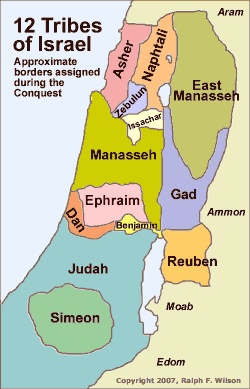
This is a map of the boundaries for the Promised Land in the reading today. There is some correspondence. But the modern day one seems more North-South pointy than the biblical one. "North-South pointy" is a technical term I just made up. The pictures on the right is from this website. The picture on the left is from this website. It is interesting to me to see what God promised them in the Bible compared to what the Israeli state possesses now. I know that the land that is now within the state of Israel was essentially taken from the Arabs living there in 1948, and I also know that since then, there has been nothing but conflict for those in Israel. It is still interesting to me to see these two maps.
There is mention of an "avenger of blood" in chapter 35. It seems that whenever a murder happened, there would be a person called the avenger of blood who would hunt down the guilty person. I do not know if this was a privately hired hit by the family of the deceased or a government issued thing. It is certainly the first time I have ever read about it, so I have a feeling this was a cultural development rather than a position ordained by God. The only way to escape the revenge of the avenger, was to seek out a city of refuge, which were predesignated towns within the territory of Israel. When the pursued got there, he was given a trial by assembly. The assembly was to hear the testimony of witnesses and decide the fate of the accused. If there was only one testimony, he was not killed, but if they were convinced by more than one testimony, then he was executed. It seems that God used this process and in a way commandeered the avenger of blood as a sort of precursor to the judge in Judges. In Numbers 35:1 it says, "The LORD said to Moses..." and then in verse 21, it says, "The avenger of blood shall put the murderer to death when he meets him." So, it seems that God condoned the practice.
Then I learned that it women and girls possibly owned land, because of Zelophod's daughters' case before Moses, and approved by God. In Numbers 36:8, it says, "Every daughter who inherits land in any Israelite tribe must marry someone in her father's tribal clan, so that every Israelite will possess the inheritance of his fathers." So, they could own land. Cool. Hooray for the development of women's rights!
Today began the reading of Deuteronomy, which is quite literally the famous last words of Moses to his people, where he summarizes their theological journey and law. I know that I have mentioned the theme of fear many times before. The fear of the LORD, the terror of God have been themes that have repeated themselves over and over. God's power is such that when we come face to face with it, dread sets in.
Deuteronomy is the first book so far that has many phrases like, "Do not be afraid..." "Do not be afraid of any man, for judgment belongs to God" (Deut. 1:17). "See, the LORD your God has given you the land. Go up and take possession of it as the LORD, the God of your fathers, told you. Do not be afraid; do not be discouraged" (Deut. 1:21). "Then I said to you, 'Do not be terrified; do not be afraid of them. The LORD you gGod, who is going before you, will fight for you, as he did fo ryou in Egypt, before your very eyes, and in the desert" (Deut. 1:29-30). So many times before, God told them to fear him. Now, though, God shows them that, when any nation is faced with the sheer power and presence of God, any nation will be brought to its knees. God is to be feared and terrified, yes, but when he is fighting and watching out for you, who else should they fear and love? The very one who terrifies us, loves us. If he is for us, who or what could be against us?
This reminds me of Romans 8:38-39, when Paul writes, "For I am convinced that neither death, nor life, nor angels, nor heavenly rulers, nor things that are present, nor things to come, nor powers, nor height, nor depth, nor anything else in creation will be able to separate us from the love of God in Christ Jesus our Lord." Amen to that.
1702 pages to go!
Subscribe to:
Posts (Atom)